The artistic and creative musings of Gillian Olson who sells cards and prints through her PS Whimsy website and displays art on Gillian Olson Art website. The weekly "Whimsy Wednesday" Behind the Brush post will feature photographs, sketches and paintings, and give you a peek into what is happening in her studio.
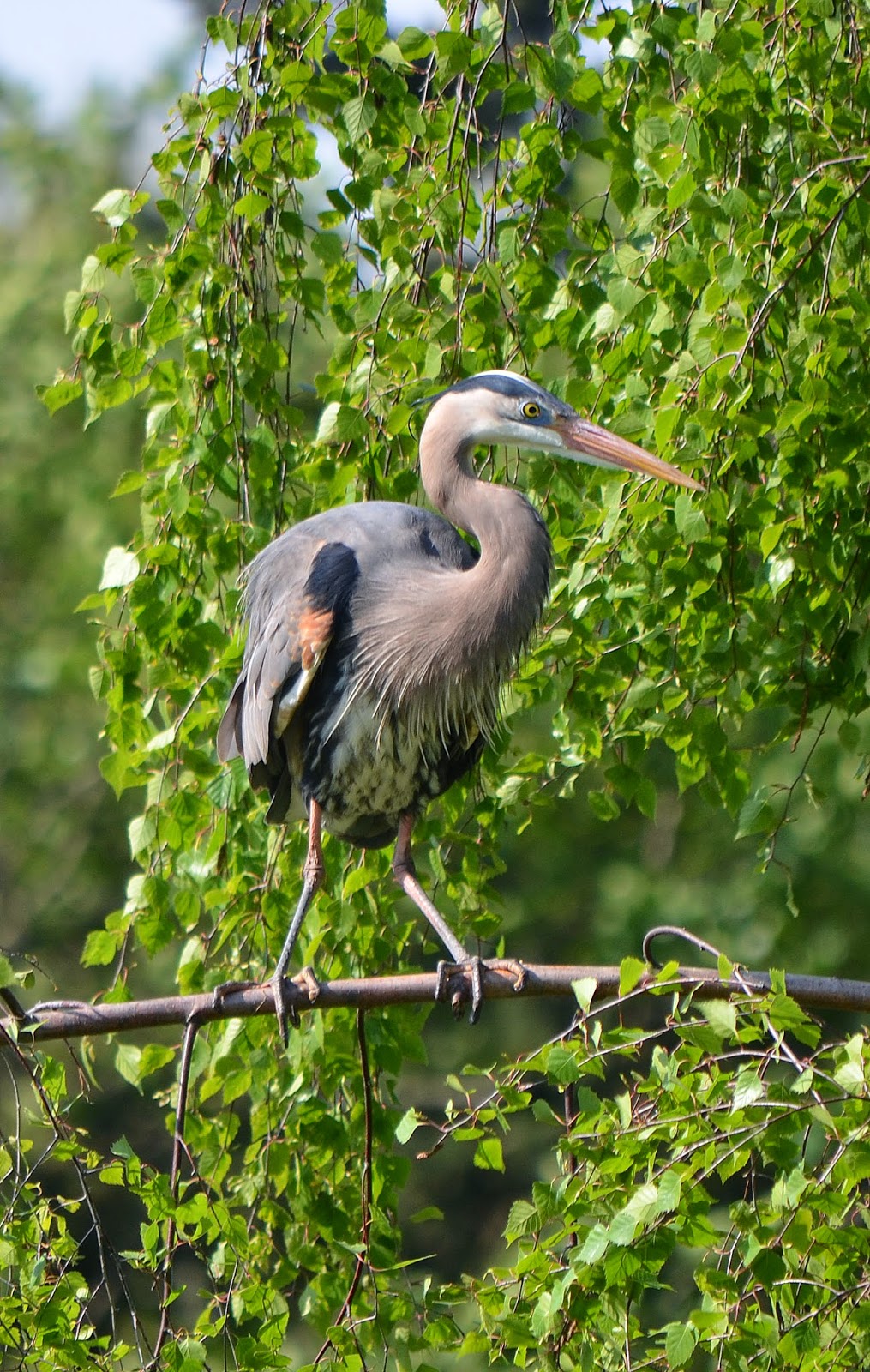
The Blue Heron is a beautiful bird to watch; it waits motionless for a fish or a frog to be within range and then suddenly lunges to intercept its prey. They are elegant in flight too, but look awkward even comical, when they first take off.
The Blue Heron "is the largest North American heron.... It has head-to-tail length of 91–137 cm (36–54 in), a wingspan of 167–201 cm (66–79 in), a height of 115–138 cm (45–54 in), and a weight of 2.1–3.6 kg (4.6–7.9 lb). In British Columbia, adult males averaged 2.48 kg (5.5 lb) and adult females 2.11 kg (4.7 lb)." Wikipedia
There have always been herons at the pond at Jericho and they are usually solitary. I have seen them chase off other herons intruding into their feeding territory.
A large group of heron have been nesting at this time of year in Stanley Park for a few years now and they are there again this year. I have also seen a small group of herons gathering at Jericho park.
Could it be that a few have decided to set up house on this side of English Bay?
I watch the heron below as it picked up and dropped several sticks ...
Then finally decided the one below was suitable and flew off with it.
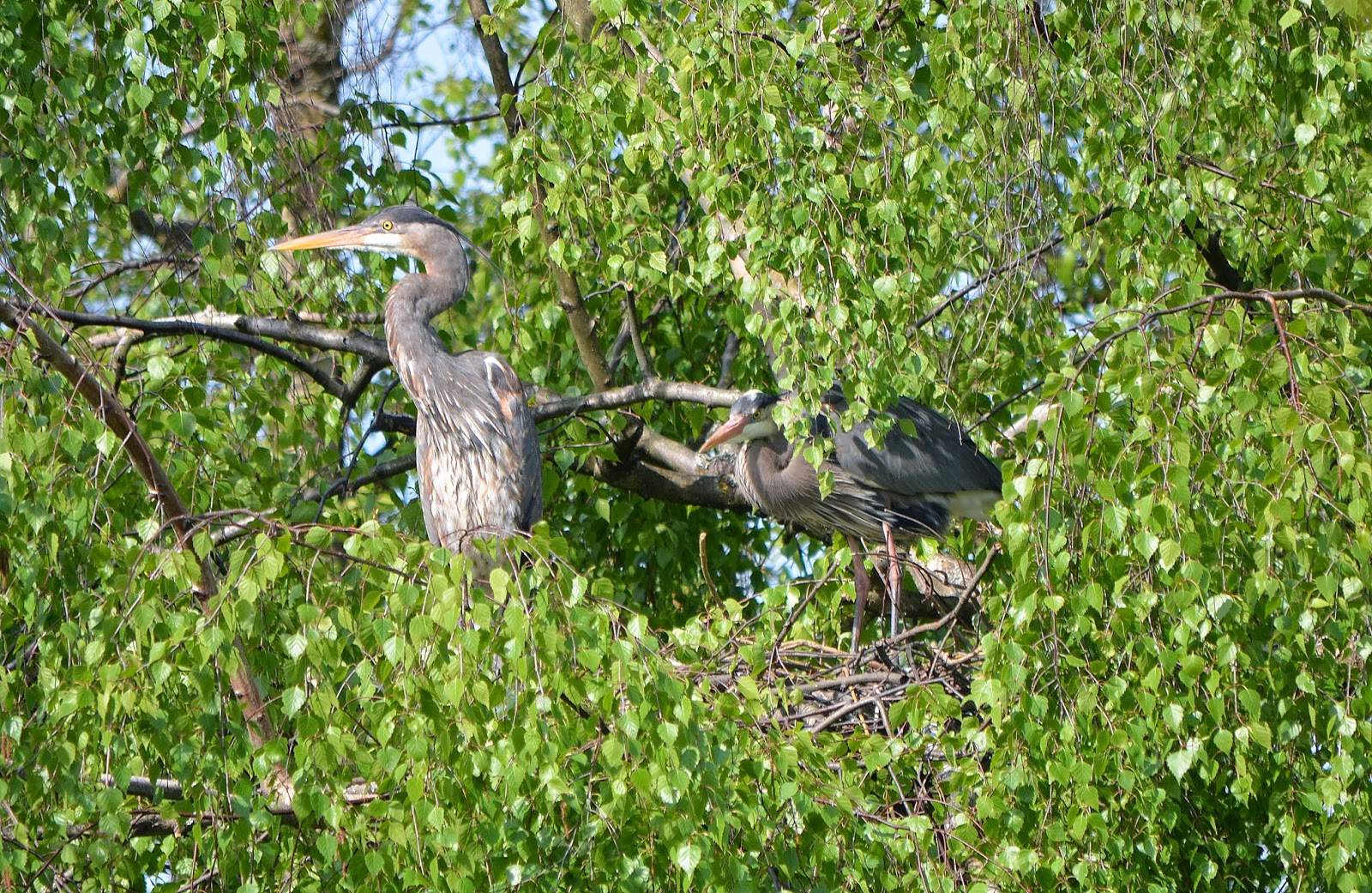
Here are two off the herons in a large willow tree I think.
And after a deal of squawking and flapping of wings the stick was placed in what looks to me like a nest.
While this was happened another pair of herons circled close to the tree, landed and then took off again. I will be watching with interest to see what happens next.
It is tulip time here. I don't normally buy tulips because I have always found that no matter what I do they droop within a few hours of being in a vase...but I recently learned a trick (probably from someone else's blog) that I will gladly share with you. Before you place the tulip in a vase (re cut the base of course) stick a pin through the top of the stem and remove to make a small hole, about 1/4 inch below the base of the flower, and they will not droop.
We had some lovely weather this week which took me out into the garden to do some cleanup, but I did manage to finish one painting. It is a watercolour again, this one is 8" X 10". Someone asked me how big my paintings are a couple of weeks ago; anywhere from 8" X 8" to 14" X 20". The larger size is a 1/2 sheet of watercolour paper, I like cold pressed paper except for portraits, then I use hot pressed or smooth paper.
Without further ado here is "Cute as a kitten":
Thank you for stopping by, Happy Whimsy Wednesday, until next time...
Do you love a good mystery? I certainly love to curl up with a good book or watch one on television. I also like visual puzzles; on my recent walks I have come across several plants that are new to me, so with the help of the Internet I am going to try to identify them. In fact the only kind of mystery I don't enjoy is mystery food, I really am rather partial to knowing what I am eating before I dig in!
First though, the mystery photograph from last time:
This is the new leaves on my mint plant seen sparkling in the late afternoon sun. I have not looked this closely at my mint before and was fascinated by the little hairs on the leaves, another picture below.
"I love to lose myself in a mystery, to persue my reason to an O altitudo!"
Sir Thomas Browne
Below is a series of fern frond emerging from the forest floor. The new growth of some ferns (fiddle heads) is edible, but the varieties that grow here on the Pacific Coast are not as far as I know.
"Fiddle-de-dee, Fiddle-de-dee, the fly shall marry the humble bee."
Nursery Rhyme
This plant was growing along the side of the road near the beach, I stopped and took pictures and asked some passersby if they knew what it was. One fellow offered to use a new iPhone app to identify it for me; he took a picture and searched but the app crashed and I was left to identify on my own. The foliage grows about a foot high and the flower heads are one to two feet above that.
Coltsfoot
Petasites frigidus, Coltsfoot or Western Coltsfoot is a perennial that blooms in early spring; I found information here:
"Stout erect stem with tight cluster of whitish to pink rayless flowers that open before leaves emerge. Flower stalks continue to lengthen as large leaves unfold. Leaves palmately divided, lobes coarsely toothed. Flowers in often purplish bell-shaped cup; male, female flowers in separate heads. Grows in bogs, stream edges, roadsides, other wet soils, at low elevations. Var. palmatus (pictured) has large leaves to 16 in. across with lobes deeply cut to base; blooms March, April. Var. nivalis has leaves less than 8 in. across, not deeply divided, with short or no teeth. Blooms July and August at high elevations, often immediately after snowmelt."
Coltsfoot can be eaten although not in large quantities due to alkaloid content: young stems and flowers can be roasted, boiled or stir fried, leaves can be cooked like spinach or leaves can be rolled up, dried and burned to ash then used as a salt substitute.
This mystery solved, Coltsfoot has strikingly pretty flower heads at this time of year.
Coltsfoot Flower head
Probably time for a picture with an ahhhhhhhhh factor. So here is a Bunny picture, only question is this Peter or Jack Rabbit?
My guess would be Jack. :)
Another mystery plant, I have seen these at the beach in the park and along the side of the road recently, a very curious looking plant:
Horsetail
This is horsetail or Equisetum; also called snake grass or puzzle grass. According to Wikipedia Horsetail "is the only living genus in the Equisetaceae, a family of vascular plants that reproduce by spores rather than seeds. Equisetum is a "living fossil", as it is the only living genus of the entire classEquisetopsida, which for over one hundred million years was much more diverse and dominated the understory of late Paleozoic forests.
The plant starts out as a odd cone shaped green shot, then develops rings of green spikes close to the stem which then open up into a grass like plant.
Horsetail plant
That solved I turn my attention to a plant that I spotted while walking along the beach, it was the small orchid like flower that attracted my attention:
This is either Red or Purple Deadnettle. Now before you get worried about the nettle part of the name, it is called deadnettle because it does not sting. It is superficially similar to a nettle in appearance but is not related and does not sting. It is actually a member of the mint family.
It is a common plant in wild areas and considered a weed in cultivated areas.
"It grows to 5–20 cm (rarely 30 cm) in height. The leaves have fine hairs, are green at the bottom and shade to purplish at the top; they are 2–4 cm long and broad, with a 1–2 cm petiole (leaf stalk), and wavy to serrated margins." (Wikipedia)
The leaves can be eaten in salads or cooked, but do not have much flavour.
"The zygomorphicflowers are bright red-purple, with a top hood-like petal, two lower lip petal lobes and minute fang-like lobes between.They may be produced throughout the year, including mild weather in winter. This allows bees to gather its nectar for food when few other nectar sources are available. It is also a prominent source of pollen for bees in March/April (in UK), when bees need the pollen as protein to build up their nest."
"You would play upon me; you would seem to know my stops; you would pluck out the heart of my mystery; you would sound me from my lowest note to the top of my compass."
William Shakespeare, Hamlet
A small selection of birds to end the post: a great Blue Heron, a Junco and a Robin all stopped to check out the photographer.
Heron
Junco
Robin
More work on my Heron paintings (now 2 in progress) this week but neither finished yet. I did finish this watercolour of a magnolia though:
Magnolia
Thank you for stopping by and thanks for your comments which are always much appreciated. I am sorry that I have not been visiting your blogs regularly recently, it's been a busy week what can I say?