Wednesday, 7 September 2016

More of Haida Gwaii

I hung my paintings in the North Shore Unitarian Church on the first of this month, they will be up until the last week of September. There are 37 paintings in this exhibit, it fills the sanctuary of the church.

I finished the last painting the day before and was readying it for hanging very early the next day before filling the car with paintings, tags, tape, and everything I needed to hang the paintings.

Here are the last paintings I finished, it is a dyptic; a varnished watercolour duo called "Pecking Order".


I will explain more about what a varnished watercolour is later in this post.


--------------------------------------

While we were visiting Haida Gwaii early this summer we took a day trip with Moresby Explorers.

The full day trip left from Moresby Camp by zodiac and stopped at World War II logging operations, and Church Creek; after a picnic lunch on the beach we got back into the zodiac and headed out into Hecate Straight and to the main stop of the day at the ancient Haida village site of K'uuna Llnagaay. (Skedans)
 .
Todays blog covers the first half of the trip. We disembarked the zodiacs and our guides took us
into the forest.


Our guide Brian talked about the forest, plants and some of the history.
 
 
A very small fungus, but I cannot remember the name:


Many pieces of forest equipment remain and the forest has grown over and around them.


During World War II spruce trees were logged to supply wood for aircraft construction.


These are ancient boots:


Mathers Creek is the site of the former village of New Kloo,  also spelled Clew. The settlement was built in 1887, the people came from T'aanuu Llnagaay (formerly Tanu). Reverend Thomas Crosby helped build the new town, which was abandoned about ten years later when residents  moved to Skidegate. The area is sometimes called Church Creek after the place of worship that once stood there, an old cemetery remains on the site. (source- Haida Gwaii - Islands of the People by Dennis Horwood)


Only the perfect trees were logged, so some old trees remain:


Before and after lunch we did a bit of beach combing since we had not yet entered the protected park area.
 
We left a few stones balanced for the next visitors to view and rearrange. 
 
 
Views from the zodiac.


More of this trip next time.
 
----------------------
 
I promised to explain more about varnishing watercolours.
 
First why varnish? It allows the watercolour to be finished without glass. When it is used for large watercolours it results in a much lighter product, and frames can be pretty expensive. This technique has allowed me to paint larger pieces.
 
I still do my watercolours on quality watercolour paper; the paper it either stretched over the same stretcher bars that are used for canvas or attached to a cradled wood panel. To stretch the paper first the paper is soaked and stretched over the frame and allowed to dry completely, the result is a taut painting surface. The second method I use is attaching (gluing) the finished painting to a wooden panel. Of  course the wood (stretcher bars or cradled panel) has to be sealed first so that it does not cause the painting to discolour. 
 
After the painting is complete and fully dry, I use spray varnish to fix the surface and then apply several coats of a water based archival varnish.
 
The finished piece can be displayed as is or mounted in a front loading frame.
 
I hope this makes some sense.
 
----------------------
 
My exhibit of 37 paintings at the North Shore Unitarian Church is the largest I have ever done.
 
Here again is the link to most of the paintings in the exhibit:
 
 
Thanks for dropping by, happy Wednesday,
 
Gillian.


Wednesday, 31 August 2016

A few birds late on a Wednesday?

Apologies for my recent absence from blogging but I have been really busy painting. I have a show that goes up at the end of this week. Here is a sneak preview of one of my new paintings. It is a varnished watercolour, 24" X 18" and is called "Memories of Skedans 1":


More about that later in this post, first here are some photographs I took of birds while visiting Haida Gwaii early this summer and a story of a crafty raven.
 
 
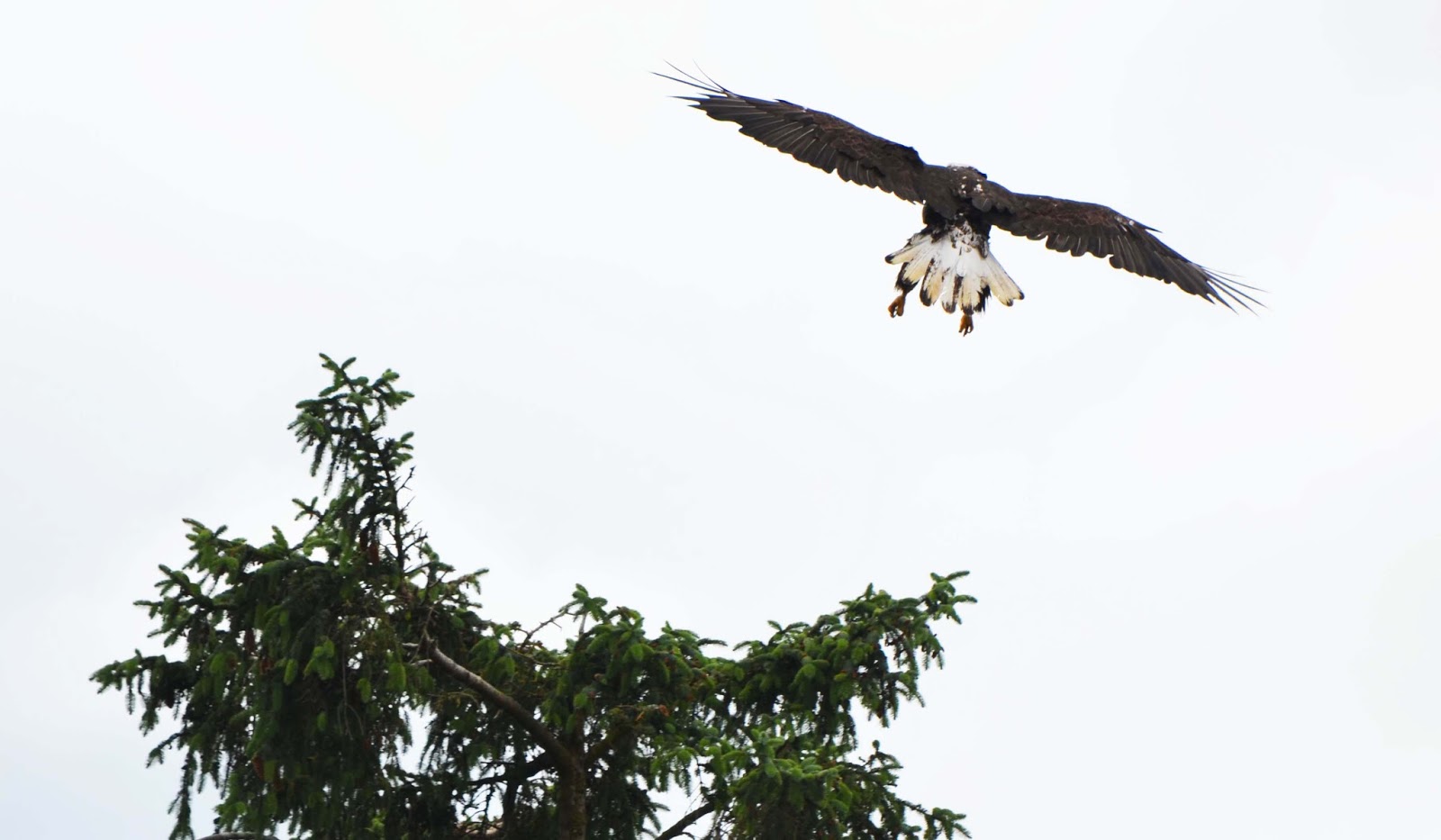
I expected to see eagles, but was surprised at the number I saw. These two seen at Port Clements:


This one looking out over East Beach:

 
These near Masset:
The eagle in the background is either an immature or a golden eagle.

 
The last three were sighted near Skitigate: 


I had hundreds of pictures of eagles, this is just a small sample.
 
A gull, there were many but I was concentrating on other birds.

 
A crow, judging by the size, but what long legs............


This is a Pigeon Guillemot. A new bird for me, and a member of the Auk family of birds.

 
Look at those red orange feet! The inside of the beak and throat are the same bright colour.
 
 
Well I promised a raven story. I was sitting watching the world go by on the beach that leads to Rose Spit at the North end of Graham Island. There was a family a short distance away that had just finished a picnic and had left their bags and were strolling on the beach.

 
I noticed a raven land and watched as it surveyed the area, I thought it was looking for scraps.
 
Notice the bag on the log; the bird landed next to it and poked at the bag and pulled out a package. Apparently there was one wiener left in the package, after a short struggle the raven had its prize! 

 
Here are pictures of it flying off:


A raven landing in a strong wind:
 
 
Hi handsome!
 
 
A Plover: 


Sandpipers strutting their stuff:


More sandpipers: 


A Sandhill Crane:
 
 
And lastly, for today, a swallow:


I  mentioned earlier that I had been busy painting. Here are a couple more new works from my studio:
 
First "Haida Song", 18" X 24", varnished watercolour:
 
 
And last one for today is "Sticks and Stones 1", 9" X 12", varnished watercolour.


 These three paintings are part of my exhibit at the North Shore Unitarian Church in West Vancouver: (370 Mathers Avenue).
 
 
You can preview all the paintings in the show at:


Thanks for dropping by, until next time, happy Wednesday (a little late in the day),
 
Gillian


Wednesday, 27 July 2016

Haida Gwaii

I have recently returned from visiting Haida Gwaii. We drove to Prince Rupert and took the 7 hour ferry ride across Hecate Strait to Skitigate. Here is some background on Haida Gwaii:


"Haida Gwaii (/ˈhaɪdÉ™ É¡waɪ/ HY-dÉ™-GWY; Haida: X̱aayda gwaay;[2] literally "Islands of the Haida people"),[3] formerly known as the Queen Charlotte Islands[4] and the Charlottes, is an archipelago on the North Coast of British Columbia, Canada. Approximately half of its population is of the Haida people.[5]

The islands are separated from the British Columbia mainland to the east by Hecate Strait. Vancouver Island lies to the south, across Queen Charlotte Sound, while the U.S. state of Alaska is to the north, across the disputed Dixon Entrance.

Haida Gwaii consists of two main islands: Graham Island in the north and Moresby Island in the south, along with approximately 150 smaller islands with a total landmass of 10,180 km2 (3,931 sq mi). Other major islands include Anthony, Langara, Louise, Lyell, Burnaby, and Kunghit Islands. A parallel name to "Queen Charlotte Islands" used by American traders, who frequented the islands in the days of the marine fur trade and considered the islands part of the US-claimed Oregon Country, was Washington's Isles.[4][6][7]

Some of the islands are protected under federal legislation as Gwaii Haanas National Park Reserve and Haida Heritage Site, which is mostly Moresby Island (Gwaii Haanas in Haida) and adjoining islands and islets. Also protected, but under provincial legislation, are several provincial parks, the largest of which is Naikoon Provincial Park on northeastern Graham Island. The islands are home to an abundance of wildlife, including the largest subspecies of black bear, and also the smallest subspecies (Ursus americanus carlottae) and the subspecies of stoat Mustela erminea haidarum. Black-tailed deer and raccoon are introduced species that have become abundant.

On June 3, 2010, the Haida Gwaii Reconciliation Act officially renamed the islands Haida Gwaii as part of a reconciliation protocol between British Columbia and the Haida people." Wikipedia


It was my first visit, but I suspect I will return. I took 2500 pictures, I will share only a few today.

We spent most of our time on Graham Island near Tlell.

It is a green paradise....


...and a beachcombers delight.


here are few of the rocks I collected. Some of these rocks are layered mudstone and from the side resemble licorice allsorts.
 
I will share some shells in future posts.
 
 
Birds and berries.


We went on a few hikes, this one to the Pesuta.


Here is an "American Gothic" picture of my sister and me.
 

Forest creatures, an elephant? (spotted near Tow Hill)

 
A Haida canoe outside the museum in Skidigate.
 
 
Nootka  rose

 
Fresh chanterelles we collected.


 Fresh thimbleberry and salmonberry scones:
Yes homemade.


Haida Gwaii, a beautiful place and  justifiably proud people.


 -------------------------------------------------
 
Art news:
 
I received a third place award at the Arts 2016 show for my painting Venetian White. The exhibit continues until August 27, 2016 at the Surrey Art Gallery.

Here is the last painting I completed before my trip, a varnished watercolour named "Heart of Gold":


 Well that is all for today,

happy Wednesday, with whimsy,

Gillian.