Wednesday, 22 February 2012

Bark, bark, bark?


Barking up the wrong tree?

This expression undoubtedly comes from watching hunting dogs barking at the base of a tree that they mistakenly think hides their prey. Happily the wily prey has left the tree and escaped in another direction.

It is generally used to mean one is making a mistake or misdirecting one's energies or attention.

The squirrel above is using a different tactic though: that if one stays absolutely still one becomes invisible. It was handy for me because it allowed me to get a good picture.

Bark has many meanings:
It is the sound uttered by a dog, but also a sound such as harsh cough or an abrupt, impatient or angry exclamation. Bark, from old English word beorcan and middle English word Berken, has probably given rise to the expression "His/her bark is worse than his/her bite".

Bark, or barque, (from the Middle English word barke, or Old French word barque for boat) is also a sailing ship with from three to five square rigged masts or a small vessel propelled by oars or sails.

But it is also the tough protective coating on the trunks, branches and roots of trees and other woody plants; the outer bark is mainly dead tissue that protects the tree from heat, cold, insects, and other dangers but also allows the tree to breathe.  This bark is a middle English word from Old Norse word borke.

It is the bark of trees that I am focusing on today, it is not only protective but also offers a wide variety of colours, shapes and textures.

We didn't have a lot of snow this winter (is it too soon to brag about that?) but here I caught a little on a tree in the park.

The spreading arms of a tree on a cool January day.


Bark of a Horse chestnut tree, curling and peeling.


I loved the shapes of this bark and the interesting shadows created by the sunshine.


A beautiful silvery colour, and delicate layers here:


Pine tree with its thick bark and, below, a pinecone (slightly off topic).


This is the puzzle-like bark of a Willow Tree. I see a face in the second one.


The flaky red bark of the Arbutus tree (the tree in front) and another tree "face".


Extracts of bark have been used for traditional medicines and tonics, tanning leather and dyeing fabrics. The strong fibres known as bast can be used for making rope and thin layers of Birch Bark are used for the iconic Canadian Birch bark canoe as well as for shelters. Commercial products such as cork, cinnamon, quinine and aspirin are all bark or made from bark.

This week I started with an old adage about barking up a tree and a picture of a squirrel and will leave you with another of each: 
"Don't keep a dog and bark yourself."

Meaning don't pay someone to do a job and then do it yourself, or interfere to the extent that they can't do the job.


I have been slowly making progress on a painting of poppies; you may recall that I "poured" the background colour. It is quite large, 14" X 21", and is a watercolour. Below is a picture after the "pour" is dry and the masking fluid is removed and then three pictures showing details of parts of it, I hope to have it finished by next week.


I have finished another  watercolour of crocuses too, and am happy with this one:


Thank you for taking the time to visit my blog, and Happy Whimsy Wednesday, until next time ......

Wednesday, 15 February 2012

Little Friends


Male Bushtit

"A bird does not sing because it has an answer. It sings because it has a song." Chinese Proverb

Female Bushtit

I recently put up some bird feeders outside my studio window. The Bushtits were the first to discover this new bounty, (I have feeders in other locations in the garden) and entertained me as I was working, with their jumping around and tweeting.

The Bushtit (Psaltriparus minimus) is a long tailed tit, and is the smallest of the passerines in North America. It is about 11 cm in length and weighs just over 5 grams.  Bushtits are a rather dull gray brown colour, with a large head and short stubby bill, short neck and long tail. The male has dark eyes and the adult female has yellow eyes.

They fly around in groups of 2 to 3 dozen (or more) and feed on insects and spiders but also eat the suet, seeds and nuts in my feeders. The flocks are quite comical to watch, they have an odd jumpy pattern of flying, when they are feeding in a tree or feeder they hop about in every direction. They constantly call out to to each other with a short "tsit" call.

I was watching as they went and grabbed nuts from the feeder in their beaks, flew to a perch and transferred the nut to their foot to eat it.

A female with piece of peanut


Male Bushtit (top) with dark eyes on the suet block


They crowd onto the suet feeder, I sometimes think they look like a pincushion with their tails sticking out in every direction.


The Bushtits share the feeder with Chickadees, Sparrows, Towhees, Juncos, Goldfinches, Starlings, Downy Woodpeckers and Red Shafted Flickers. The Crows and Squirrels (black and gray) also come by for a meal.


Staying with the bird theme here are some pictures of an albino hummingbird. I did not take them they were taken by Marlin Shank (but they were so beautiful I wanted to share them with you):

Fifteen-year-old photographer Marlin Shank was fortunate enough to capture 
several images of a rare albino ruby-throated hummingbird while in a park in 
Staunton , Va


You can click on any of the photographs to enlarge them, if you do so for the last one you will be able to see the ring of feathers surrounding the eye. They are amazing birds.

It has been a busy week for me and my sisters. My Mum is finally ready to leave hospital later this week after a fall causing a compression fracture in her lower back; she now needs more care than before so we have been struggling to find a safe but welcoming environment for her but one that offers her the support she now needs. I have my fingers crossed that we have found somewhere with a good balance.


One last bird shot in honour of Valentine's Day: a pair of Parrots happily sharing each others company.


"Birds on the Wires":


 Thank you for dropping by and Happy Whimsy Wednesday. Until next week......

Wednesday, 8 February 2012

Prelude to Spring?

February 2 was Groundhog Day. According to legend, if a groundhog emerges from its burrow on Groundhog Day and sees its shadow, there will be six more weeks of winter.

According to the National Post Newspaper:
"The country’s (Canada's) first two furry forecasters have brought good news to winter-weary Canadians on Groundhog Day: Nova Scotia’s Shubenacadie Sam and Ontario’s Wiarton Willie both failed to see their shadows Thursday morning." 
That means, according to tradition, an early spring is on its way.

No groundhogs here, so I went to check on the locals: first there was Jack (Rabbit), no shadow, and then some of his friends, still no shadows, and then Blackie (Squirrel) and definitely no shadow. So maybe it's true.


Groundhog Day began as a Pennsylvania German custom in southeastern and central Pennsylvania in the 18th and 19th centuries. It origins are from old European weather lore, where a badger or a sacred bear was used as a weather predictor rather than a ground hog. The groundhog tradition is connected to similar beliefs associated with Candlemas Day (February 2) and  early Christians in Europe; for centuries the custom was to have the clergy bless candles and distribute them to the people marking a milestone in the winter and using the weather on February 2 as a sign of what was to come.

An English poem:
"If Candlemas be fair and bright,
Winter has another flight.
If Candlemas brings clouds and rain,
Winter will not come again." 
I have seen some early blooms, are these a prelude to Spring or just a cruel tease?

First there is Witch Hazel's bright and dazzling blooms. Witch Hazel blooms through the Winter and into the Spring. Did you know that an extract of the bark and leaves has medicinal uses such as treating bruises, scrapes and insect bites?


Witch Hazel Blooms


Snowdrops are among the earliest flowers of spring, sometimes they bloom through the melting snow. The snowdrop comes from a small bulb that when established multiplies each year; I have thousands in my garden as a result, in flower borders and coming up through the grass. They are an elegant and welcome sight in early spring.


Hardy Heathers bloom through the winter and early spring, I have seen a range of colours from white and yellow to pink and purple.


Another early bloom is this Veronica, a low growing plant with tiny bluish flowers.


These are blooms of the Viburnum (bodnantense) tree and after seeing a number of them on my walks recently and I asked a Parks Board employee the name. They are in clusters of bell or trumpet shaped flowers and have a beautiful sweet scent.


I saw two different varieties of Oregon Grape, the first one a tree, the second a bush.


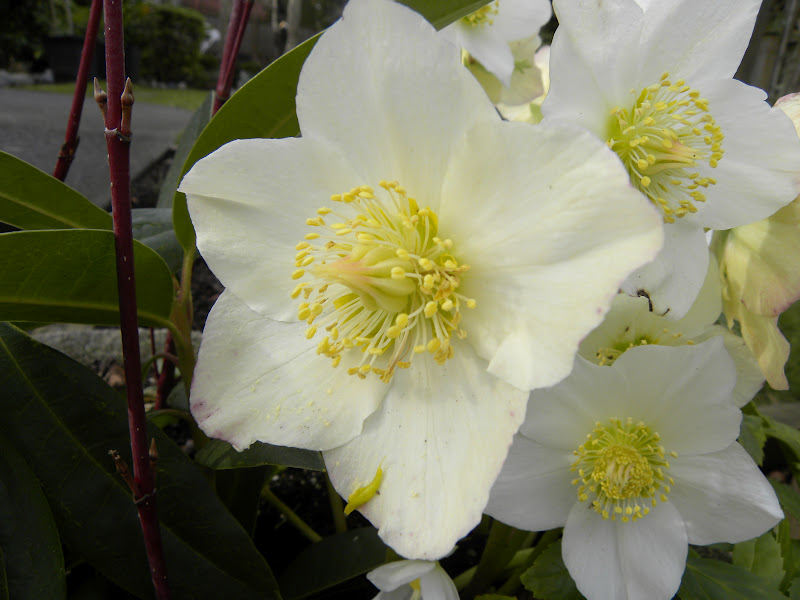
Here is a beautiful Hellebore (from my neighbors' lovely garden), this is a hardy flower that blooms through the winter and spring. It has beautiful five petalled flowers as you will see in these next photographs.


This Rose bud seemed to be as shocked by the weather as I was to see it starting to bloom.

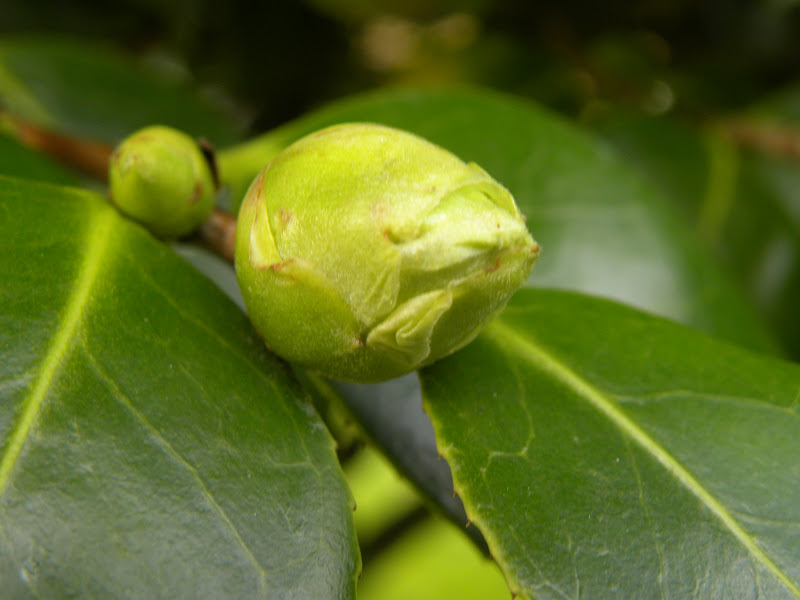
The truth is most or all of these flowers usually start to bloom in the winter, so none are proof that we will have an early Spring. The last few pictures are of buds on plants or trees that should start to flower soon. A Camellia, a Magnolia, a Pussy Willow and lastly a Clematis.

Camellia bud
Magnolia bud (above and below)


Pussy willow (the one in the middle is just starting to emerge)

Clematis bud (above and below)


Clematis bud starting to open

I have been working on more colourful spring flowers this week.

Here are a couple of things I have been working on this week. I have been experimenting with pouring backgrounds and negative painting technique. Both pictures are watercolours, the first titled Snowdrops (for now) is an experiment with negative painting, or painting the space around the image (the positive space) rather than painting the image per se. I am fairly happy with this one but not happy with the way it scanned, you will no doubt notice the darker bar across the top. I will rescan it after I remember to sign it.
This picture is a poured background and painted foreground of Crocuses. I am not happy with the composition and I am working on another.


Well not Groundhog but will Hound dog do? Here's Elvis Presley with "Hound Dog".


I appreciate you taking the time to drop by my blog. Happy Whimsy Wednesday, until next week..........