Well I'm back from vacation, having satisfied my wanderlust for now; I took over 3000 pictures, so be warned you will be seeing quite a few in the coming weeks.
To digress slightly, I think wonderlust is an interesting word, originally from German words "wandern" (to hike) and "lust" (desire), it became an English term at the beginning of the 20th century meaning enjoyment of roaming or wandering or craving for travel.
Today I am going to share some highlights and reflections of our trip; reflections or impressions as well as those created as in a mirror.
We travelled to first Paisley, Scotland, then a few days in London and Paris, 2weeks in the Luberon in a rental house and then brief stops in Annecy and Lyon; a lot to pack into a month away.
"Paisley is the largest town in the historic county of Renfrewshire in the west central Lowlands of Scotland and serves as the administrative centre for the Renfrewshire council area. The town is situated on the northern edge of the Gleniffer Braes, straddling the banks of the White Cart Water, a tributary of the River Clyde.
The town, a former burgh, forms part of a contiguous urban area with Glasgow, Glasgow City Centre being 6.9 miles (11.1 km) to the east. The town came to prominence with the establishment of Paisley Abbey in the 12th century, an important religious hub in mediaeval Scotland which formerly had control over the other churches in the local area." (Wikipedia)
We were in Paisley because my husband attended a conference in Paisley. Expecting cool weather I took rain gear and fleece jacket, and we were surprised by brilliant sunshine and temperatures in the 25 to 30 C range. The locals were clearly surprised by the weather and surprisingly many apologized for the unusual hot weather.
This is the town hall building in Paisley Scotland, the site of the "Paisley Snail Conference", but more on that in a future post.


 |
| Reflection of Abbey |
 |
| Ceiling of the Abbey |


Above detail of the tower and below a view of the Abbey showing the cloister. In the 15th and 16th C the Abbey was damaged by a series of fires and the tower collapsed, after which the site was plundered for its stone. The restoration of the Abbey began in the mid 19 th century and was completed in the eary 20 th C.

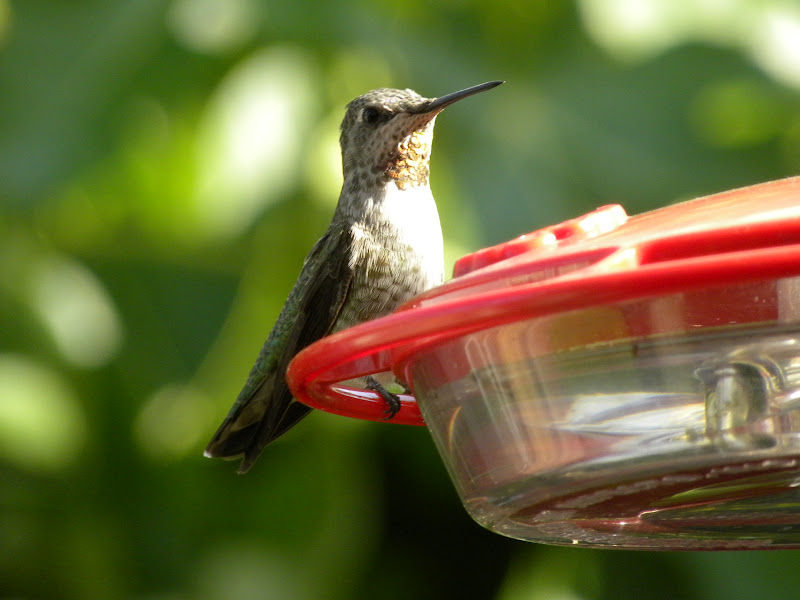
I always have time to admire the flora and fauna, and of course take pictures.


Paisley is the home of the paisley pattern:
"By the 19th century, Paisley had established itself as a centre of the weaving industry, giving its name to the Paisley Shawl and the Paisley Pattern."
"Paisley, as with other areas in Renfrewshire, was at one time famous for its weaving and textile industries. As a consequence, the Paisley pattern has long symbolic associations with the town." (Wikipedia)I visited the museum which featured the history of the Paisley pattern and Paisley Shawls .


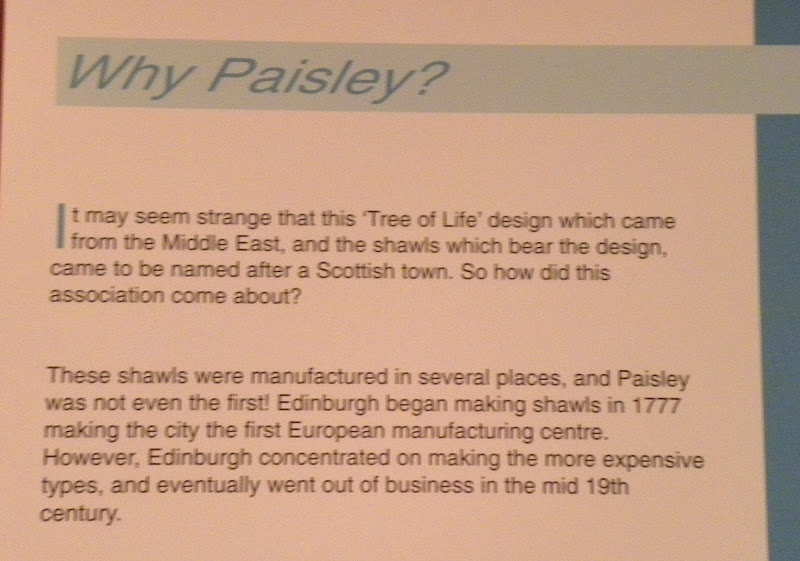


The museum gives a history of the shawl which I will summarize for you:
In the early 19 C with the simplified fashions that followed the French Revolution, shawls were a popular accessory (to add some colour), with large rectangular shape being the most popular. In the 1820's came flared skirts and a change in the popular shawl shape to square, worn folded diagonally into a triangle and draped with the point down the back. Shawls were often used as alternatives to coats with the large crinoline skirts of the 1840's; so the rectangular shape was back but the size was much larger. It was the "bustle" dress style that finally quelled the shawls popularity, as a shawl worn over a bustle created an unflattering silhoette and hid the visual point of the style.
Oh, I also made time to sample the foods, after all what's the point in travel if you don't try some local fare; had hagis too but preferred the icecream.

Paisley is a short train ride from Glasgow. The downtown centre of Paisley is attractive and clean and the people are welcoming. There are many empty stores with for let signs though, evidence of the poor economic times.
After our short stay in Scotland it was on to London for a few days and visits with friends and relatives.

I was enjoying using windows to capture reflections, below in a church window followed by a reflection in window at Sommerset House.


Sorry, I can't remember what this building is but loved the reflection.


On the Way to Regent's Park we passed Baker Street, of Sherlock Holmes fame, next door is Hudson's restaurant. I will save the Regent's Park pictures for a later post.

The weather was beautiful causing me to seek out green spaces; I spotted some beautiful flowers and an English Robin in my wanders.


We journeyed out into the country to visit relatives and had a most enjoyable lunch at a country pub. It looks empty because it was a beautiful day and everyone was enjoying the Pub fare outside.

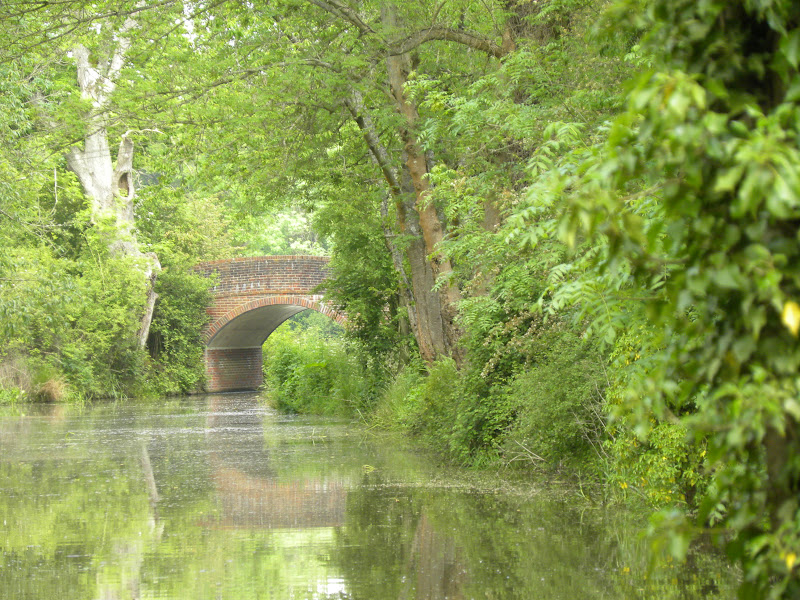
Then we for a walk after lunch along canal and walking path past an old mill and more reflections, including one of the photographer caught in the act.



Still lots more pictures and stories to come, more next time.
I really enjoyed my vacation but I must say it is great to be back home again. After all the wonderful sights and experiences home looks pretty darn good too!
"Mid pleasures and palaces though we may roam,
Be it ever so humble, there's no place like home."
John Howard Payne
I took a bit of a break from my usual blog visiting while on vacation, a combination of no internet access, slow connection, lack of time and sometimes just plain sloth, but now that I am home I hope to get around to visiting all your blogs soon.
Thanks for dropping by, and happy Whimsy Wednesday, until next week ......