Wednesday, 16 November 2011

November in the Garden


On a recent cool, but sunny,  November afternoon I visited the Nitobe Garden at the University of British Columbia (UBC).  Located on North West Marine Drive this 2.5 acre traditional Japanese garden is part of the UBC Botanical Garden. This time of year the garden is colourful, peaceful and open to all by donation. According to the UBC Botanical Garden website:
"Nitobe Garden is considered to be the one of the most authentic Japanese gardens in North America and among the top five Japanese gardens outside of Japan, the Nitobe Garden includes a rare authentic Tea Garden with a ceremonial Tea House."


"The garden honours Inazo Nitobe (1862-1933) whose goal was "to become a bridge across the Pacific." Among many other memorials to him is his portrait on the 5000 yen note."

"Each tree, stone and shrub has been deliberately placed and is carefully maintained to reflect an idealized conception and symbolic representation of nature. There is harmony among natural forms - waterfalls, rivers, forests, islands and seas - and a balance of masculine and feminine forces traditionally attributed to natural elements. Realizing that many native trees and shrubs could be trained and pruned in typical Japanese fashion, the garden's creators incorporated them as unique features. Some maple and cherry trees and most of the azaleas and iris were brought from Japan. A place of reflection, where each step reveals a new harmony, the garden is designed to suggest a span of time - a day, a week or a lifetime - with a beginning, choice of paths, and ending."
The central pond is a home to Koi, or carp, but they are not visible this time of year. When I asked where the fish were I was told that they do not feed them regularly at this time of year because they are not able to use the food, so the fish stay out of sight. I found a reference that suggests that the Koi fish have either a small or no appetite during the winter and that their ability to digest proteins in the winter is nearly zero; I think this is related to the lower temperature of the water in the fall and winter.

The trees, especially the maples, display spectacular colours this time of year creating beautiful reflections in the pond.


The garden contains small and mature deciduous trees as well as towering evergreens. Colourful leaves float in the water and collect around the small waterfalls. The sound of water trickling adds to the meditative atmosphere. People walk slowly in the garden, some sit on benches and appear lost in thought.


Nitobe Inazō's hometown of Morioka, Japan dedicated this plaque in his memory. He died in Victoria, British Columbia, which is now the sister city of Nitobe's home town.


The walkways, paths and bridges in the garden offer the visitor many vantage points to view the garden. The symbolism in the garden includes all of the elements and is focused by the paths and bridges which represent a span of time. Guided tours can be arranged to explain the garden's many elements.

There are several interesting lanterns in the garden: below are pictures and details of them. Lanterns were introduced into Japanese tea gardens by tea-master Sen-no-Rikkyu, after which they became a major garden element. The lanterns were necessary to guide guests to the tea-room for Japanese tea ceremonies that were often held in the evenings.


The tea-house is in one corner of the garden, it has its own small garden and is surrounded by a bamboo fence:
"The tea house of the Nitobe Garden, Ichibō-an (Hut of the Sweeping View), is a classical example of a structure designed for the practice of the Japanese discipline called chadō (Way of Tea). To that end, it is equipped with all the elements needed for the conducting of a complete tea gathering, namely, a waiting room (machiai), outer garden (soto roji), waiting bench (koshikake machiai), middle gate (chūmon), inner garden (uchi roji), main tearoom (hon seki) and preparation room (mizuya). "


The wall of the garden and the entrance way have a narrow overhanging tiled "roof" which is beautifully finished.


Just outside the garden I saw these "toadstools" among the needles and cones, and some leaves caught in a sunbeam also begged to be photographed.


Joni Mitchell "Back to the Garden"


It seems I have been busy with everything except painting recently. I am selling my cards and prints at a Craft Fair on the weekend and have spent a lot of time getting organized for that event. I have, however, managed to finish the following painting which is a watercolour that I have named Fall Colour III. It is the third, and last I think, in this series.
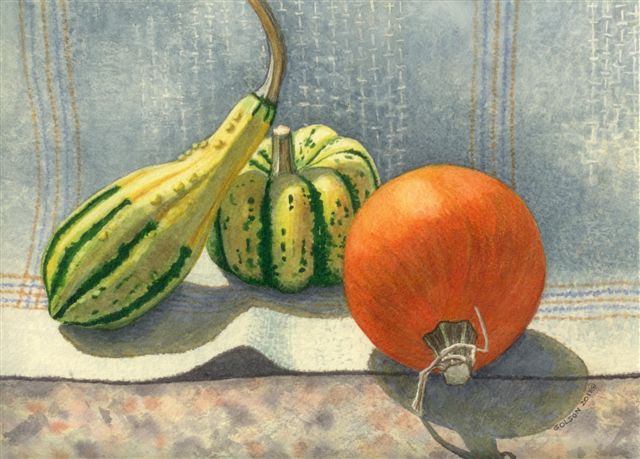
Fall Colour III
In the mood for a craft fair? Come and visit me at the Delbrook Craft Fair:

Delbrook Christmas Craft Fair: Sunday, November 20, from 10 am to 4 pm, at Delbrook Community Recreation Centre - 600 West Queens Road in North Vancouver. I have  a table (#86) in the Tamarack Room.

Thank you for visiting my blog, and happy Whimsy Wednesday. Hope to see you again next week,

Wednesday, 9 November 2011

Remembering


Remembrance Day or Armistice Day is observed annually since World War 1 on November 11 in Commonwealth countries to  remember the members of their armed forces who have died in the line of duty. The November 11 date was chosen because the official end of World War I was on that date in 1918. The formal end to hostilities was marked at 11 am by the German signing of the Armistice. The 11th hour of the eleventh day of the eleventh month is when Remembrance Day Ceremonies are held at War Memorials throughout Commonwealth countries.

The United States honour their military veterans on the November 11 as well with Veterans Day.

Lapel Poppy

The red remembrance poppy is a familiar emblem of Remembrance Day; it has been used since 1920 to commemorate soldiers who have died in war. The use of the poppy was inspired by the First World poem "In Flanders Fields" written by Canadian physician Lieutenant Colonel John McCrae, who died in the war.


The opening lines of the poem refer to the many poppies that were the first flowers to grow in the churned-up earth of soldiers' graves in Flanders (a region of Europe that overlies parts of Belgium, France, and the Netherlands.)  The poppies bloomed across some of the worst battlefields of Flanders in World War I, their brilliant red colour an appropriate symbol for the blood spilled in the war.  The horrors of that war and the huge loss of life on both sides (mostly young men sent to their deaths over quagmires left from constant bombardments against the fortified trenches of the other side) are hard to imagine today.


Poppies growing wild at the side of a road


In Flanders Fields by John McCrae:
 "In Flanders fields the poppies blow
Between the crosses, row on row,
That mark our place: and in the sky
The larks still bravely singing fly
Scarce heard amid the guns below.

We are the dead: Short days ago,
We lived, felt dawn, saw sunset glow,
Loved and were loved: and now we lie
In Flanders fields!

Take up our quarrel with the foe
To you, from failing hands, we throw
The torch: be yours to hold it high
If ye break faith with us who die,
We shall not sleep, though poppies grow
In Flanders fields"


Remembrance Day ceremonies are marked by a period of silence at 11 am, a time for solitary thought.

At this time of year I remember my father who fought in the Second World War. He was in the British Artillery and was captured early in the conflict and spent years in Prisoner of War camps.


My Dad in his uniform
 
He survived, returned to Britain, met and married my mother and raised 6 children. We moved to Canada many years ago.  My father has since passed away.

I remember attending Remembrance Day ceremonies with my family. My father would wear his medals and stand at attention, honouring his fellow soldiers. The ceremony included singing the National Anthem, a tribute to the fallen, the laying of commemorative wreaths and the playing of the Last Post: followed by a 2 minute silence.


The ceremony always seemed to have a piper, with the plaintive sound of the bagpipes. To this day the sound of bagpipes brings to mind standing with my father at the War Memorial. My Dad never talked much about the war, never glorified war and hoped that we would never have to experience such a conflict.  In his time young men did their duty and served their country.  It did not occur to most of them to question what they were doing or why they were doing it.


After the war his family gave him the letter confirming that he was a prisoner of war and where they could send letters to him. He kept his service and pay book as well.

After the war some of his fellow soldiers produced a publication called "Barbed Wire"


This post is dedicated to my father and all the young men and women who have fought to make the world a better place for their children and children's children.


Thank you for visiting my blog, I hope you'll come by again next Wednesday.

Wednesday, 26 October 2011

All Hallows Even


Jack-o-lanterns

“Halloween”, or Hallowe’en” shortened from “All Hallows Even” is the evening before Hallomas or All Hallows Day which falls on November 1st..

Hallowe’en (October 31) activities happen mostly in the evening. Traditional theme colours are orange and black. Prior to Hallowe'en evening decorations such as carved pumpkins (jack-o-lanterns) are placed in windows and by doorways. Children go trick-or-treating in the early evening and later families gather for bonfires and/or fireworks displays.


Black and orange decorations (above and below)

I liked this mix of leaves with the webs


Trick-or-treating involves dressing in costume and  going from house to house, asking for treats such as candy or sometimes money, with the question, "Trick or treat?" The word "trick" refers to a (mostly idle) threat to perform mischief on the homeowners or their property if no treat is given.  Trick-or-treating may have come from the Hallomas medieval practice of the poor going from door to door to receive food  in exchange for saying prayers for the dead.

Pumpkins ready for carving


The carving of jack-o'-lanterns dates from the custom of carving turnips into lanterns as a way of remembering the souls held in purgatory. The turnip was traditionally used in Ireland and Scotland at Hallowe'en, but in North America pumpkins are used because they are more readily available and easier to carve because they are bigger and hollow. If you carve a pumpkin, you may want to put the seeds aside for roasting (just wash them, let them dry overnight, then coat them lightly in oil and salt and roast at 275 F for about 1 hour).


My carved pumpkin

Pumpkins range in size and shape, but now there is also a white pumpkin available. The white or albino pumpkin is also called a Ghost or Casper pumpkin.


Ghost pumpkins above and below


Colourful pumpkin display

Costumes for Hallowe’en once were largely monsters, ghosts, skeletons, witches, and devils but today often also include characters from popular shows or movies like Darth Vader and Spiderman as well as ghouls and zombies.


Decorations range from simple, just a carved pumpkin, to elaborate, where front yards are made to look like graveyards or haunted houses. Some people must spent days getting their displays ready, there are one or two quite elaborate displays in our neighbourhood that kids of all ages stop by to have a look at.

Skeleton Lights

Gargoyle statues

I usually do quite simple decorations for Hallowe'en, saving the over the top decorating for Christmas. My carved pumpkin never seems very imaginative and often looks a bit like it was carved by someone with no opposible thumbs.

Firecrackers, even though not strictly legal here (fireworks OK), can be heard on Hallowe'en as well as a week or two either side of the day. Fireworks displays, often organized within neighbourhoods, keep the kids and adults entertained after the treat-or-treating is done.

Happy Hallowe'en to all, but remember to keep the gore in check, it scares the little ones, and to keep your pets safe inside.

Continuing with the orange and black theme colours, here a a few pictures from a weekend visit to the south Okanagan Valley's wine region and the neighbouring Similkameen Valley wine region. It is harvest time but most grapes are late this year because of the cool spring and early summer.  These two areas have a number of our favourite wineries which my husband visits twice a year to buy wine and talk to the owners.  In future posts I will tell you about some of them.  Both valleys are worth exploring for the interesting wines and the wonderful produce grown there.


Bright orange squash

Squash including "Spotted Swan"

Ripe sunflower head


Almost black grapes still hanging on vines

Beautiful foliage

Misty morning

Fall grasses still damp from the mist
The birds were eager to sample the grapes still on the vines and can be seen flying in large flocks.

House finch high on the wires

Starlings were flying around in large flocks


Vineyard in fall colour


Black Bugbane in bloom


Special Offer - 
Cards by the dozen - $36.00 for 12 (plus postage and handling)
Follow this link for Seasonal and greeting cards:
http://pswhimsy.myshopify.com/collections/greeting-cards/
Follow this link for Thought for Food cards:
http://pswhimsy.myshopify.com/collections/thought-for-food/

Coming this weekend:
October 30, 11am -2pm:
ART SHOW @ Knox Fellowship Hall
My painting friends and I will be having an art show and sale at Knox Fellowship Hall on Sunday, October 30, 2011.
Knox Fellowship Hall is located beside Knox United Church at 5600 Balaclava Street, one block east of Blenheim just north of 41st Avenue.
There will be a variety of media (watercolour, acrylic, oil), subjects and sizes of original work and light refreshments will be served. Hope to see you there.
I will be featuring mostly cards (Christmas, food and Nature) but will have a couple of new paintings as well.


Thank you for visiting my blog and happy "Whimsy Wednesday".