Last week I visited the Greenheart Canopy Walkway located in the Botanical Garden . The Botanical Garden website offers this description:
“Located in theand open year-round, the Greenheart Canopy Walkway is a 308-metre (1010 feet) aerial trail system that offers a rare perspective of the natural beauty of the west coast forest canopy ecosystem. It is the only one of its kind in David C. Lam Asian Garden .” Canada
"Guests traverse bridges suspended around 50 feet in trees that are over a century old. This experience is an exciting and adventurous way to interact with nature and the forest.
Greenheart's approach is to provide access to the canopy with minimal impact on the trees or habitat. On the walkway, trees are used to support suspension bridges using patent pending ‘tree hugger’ technology. The prefabricated walkways are designed to allow individuals to transport the pieces into remote sites, so that no roads need to be built, nor helicopters required.
The Greenheart Canopy Walkway has eight tree platforms more than 15 metres above the ground with a ninth, a two-storey platform, on a free-standing tower reaching more than 22 metres in the air. The longest bridge is 50 metres long. The total length of the walkway is 308 meters. Construction is as non-invasive as possible using the patent pending ‘tree hugger’ suspension system. The tree hugger uses no nails or bolts or intrusive fasteners of any kind, using instead, a variable tension system to provide the least amount of infringement or impact on the trees.”
Here are pictures of visit and some background on what I saw:
 |
| The walkway up to the first platform |
 |
| Looking back from first platform |
As we travel along the walkways from platform to platform Brian describes the plants and trees.
 |
| Taiwanese Coffin Trees |
The timber of Taiwanese Coffin Tree is easy to work, light, durable and pleasantly scented and is used to make a variety of products such as furniture, bridges, boats and coffins.
 |
Branch of Twainese Coffin Tree |

The platforms are suspended from Grand Fir, Douglas Fir and Red Cedar Trees.
How does the green canopy walkway work?
There is a network of cables that holds each platform in suspension, working rather like the Chinese finger puzzle, they grip the tree in response to a load, in this case a group of visitors. When the tour moves along to the next platform the network of cables on the tree relaxes. The platform floor is fabricated of aluminum making a light weight but extremely strong structure which is held against the trees without penetrating or damaging them.
 |
| Platform surrounding fir tree |
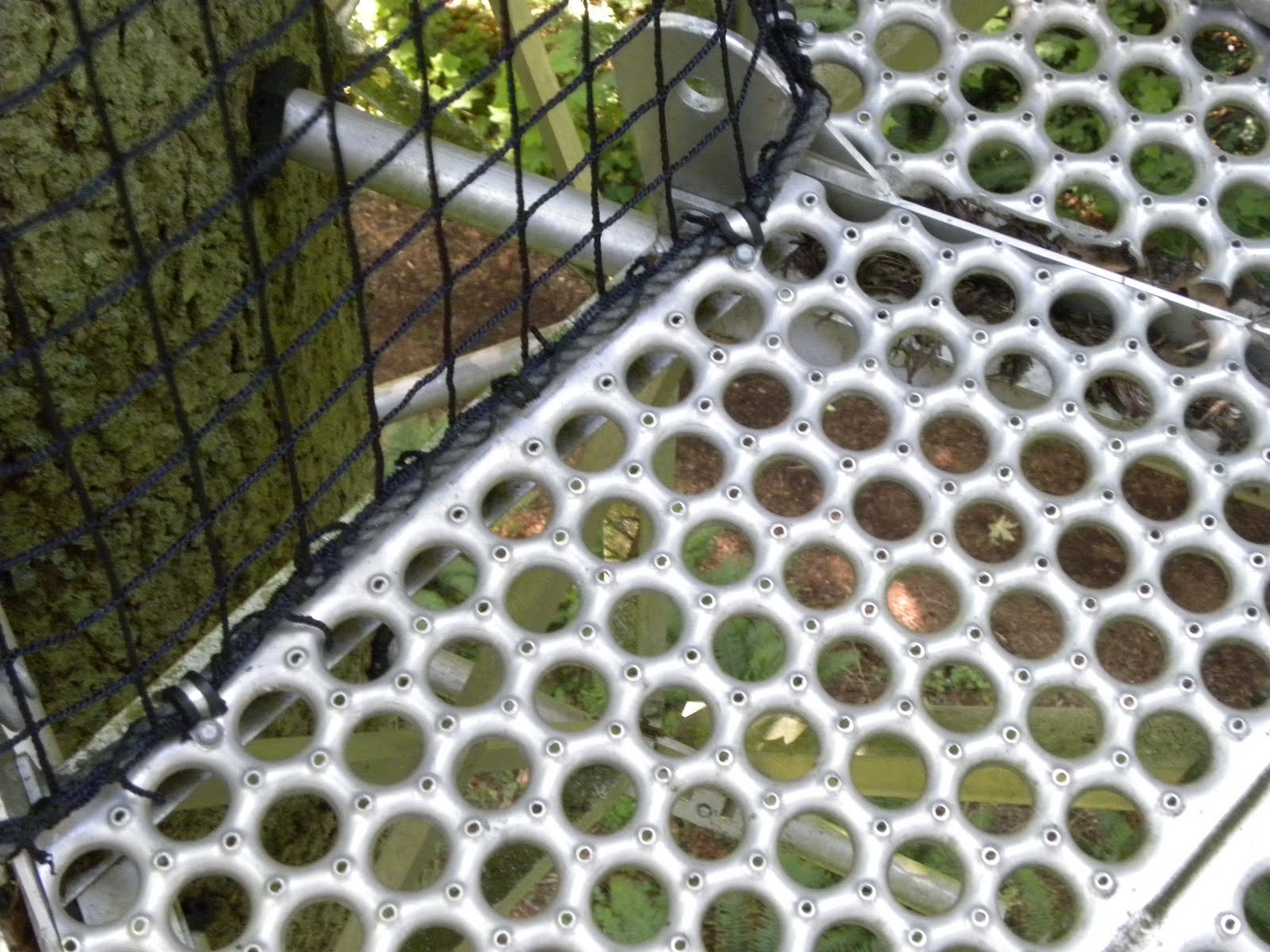 |
| Detail of platform |
Between the platforms are a series of aerial walkways, 15 inches wide, with safety netting and cables. The walkways are safe but do move from side to side and up and down, a feeling that I got used to after the first walkway on which you ascend to about 45 feet above the ground. As the group moves along the route Brian describes the surrounding flora and fauna and how the walkway provides support while causing a minimum impact on the trees.
Pictures of the cabling network around the trees that provide support for the platforms:


 |
| Grand Fir Tree |
The first platform is suspended from a Grand Fir Tree (Abies grandis). A tree that is native to the Pacific Northwest and found in forests from sea level to 900 metres altitude. It is a large, 40 to 70 metres tall, fast growing tree, and can have a trunk diameter of up to 2 metres. The leaves or needles grow in a single plane which distinguishes it from other fir varieties. It has an attractive orangish scent, which makes it a popular choice for Christmas trees or for boughs for Christmas decorations.
The Grand Fir was valued by First Nations Peoples for its aromatic and healing qualities. The inner bark of the Grand Fir and needles (boiled to make a medicinal tea) were used for treating colds, the pitch was used as a healing salve or mixed with oil to be used as a deodorant or rubbed on the scalp to prevent balding. Cut boughs were used inside as air freshener and burned as incense to make a purifying smoke to ward off illness.
 |
Sampling the pitch of a Grand Fir |
 |
| Douglas-fir |
Douglas-firs are medium-size to large evergreen trees, 20–120 metres (70–390 ft) tall. The name Douglas-Fir honours David Douglas, the Scottish botanist who first introduced the tree into cultivation in the early 19 th century. The hyphen in the name indicates that Douglas-firs are not true firs, they are members of the genus Pseudotsuga (meaning "false hemlock") or hyphened as Pseudo-tsuga.
The Douglas-fir has needles (singles not grouped as in some pines) that are 2 to 4 centimetres long that completely encircle the branches, this distinguishes it from the Grand Fir. The Douglas-fir has cones with 3-lobed bracts sticking out between the scales. The cones hang down rather than sticking up as in true firs. The bark is thick and deeply furrowed.
 |
| Douglas-fir with cable network supporting platform |
 |
| Bark is thick with deep furrows |
 |
Cones showing the bracts between the scales |
 |
| Needles completely surround the branches |
Douglas-firs are intolerant of deep shade and young trees rarely survive for long within the shaded forest understory. Douglas-firs possess thicker bark and have a somewhat faster growth rate than most other trees in the temperate rain forest, giving them a competitive advantage when the forest experiences a major disturbance such as fire, clear cut logging or wind storms which create openings in the forest allowing the Douglas-fir to regenerate in the openings. Low-intensity fires often leave Douglas-fir trees standing.


 |
| This is the tree soaring above the burn damaged base |
First Nations people used Douglas-fir wood and boughs as fuel for pit cooking, and the boughs for covering the floors of sweat lodges.
The wood of the Douglas-Fir is extremely hard, strong and durable. It is used for dimensional lumber, timbers, pilings, plywood, railroad ties, mine timbers, house logs, posts and poles, flooring, pulp, and furniture.
Coast Douglas-fir trees are used extensively in landscaping and are a popular as Christmas trees.
 |
| Western Redcedar |
 |
Redcedar bark |
The Western Redcedar is an evergreen coniferous tree in the cypress family and is the Provincial Tree of British Columbia. It is a large tree, ranging up to 65 to 70 metres tall with spreading trunk that can measure 3 to 4 metres in diameter at the base; the branches are drooping but turn up at the ends. The Redcedar is a long lived tree with individuals living well over one thousand years.
The Redcedar has scale like leaves which occur in overlapping pairs, green to yellow green and very aromatic scent. The bark is grayish in colour and is stringy and can be torn off in strips. The reddish-brown soft wood is very straight grained and contains fungicides that prevent it from rotting. Giant stumps can still be found in forests around the Lower Mainland with springboard scars from logging in the 19th and early 20th centuries.
 |
| Old stump showing springboard scars and looking rather like a face |
The resistance to rot makes the wood a popular choice for shingles, decking, siding and fencing, especially in the Pacific Northwest ’s damp climate. Aromatic oils in the wood are believed to deter insects, thus being a natural moth repellent, the wood is often used for closets and blanket chests.
 |
Redcedar branches |
The Western Redcedar played a vital role in the lives of the peoples of First Nations on the northwest coast of North America , who used the trees branches, bark, wood and roots. They made rope, lines and fish traps from the skinny branches. They harvested the bark in long strips from live trees and beat it soft to make clothing, bedding and bandaging. The bark and roots were woven into baskets, hats, mats and nets. The light, fragrant, reddish wood of western red cedar is soft enough to be worked with tools made of stone and bone. From the wood First Nations people made totem poles, canoes, houses, cradles, coffins, tools, dishes, weapons and fishing hooks. When steamed, the wood becomes flexible and was bent into boxes and drum frames. Coastal First Nations people learned to harvest bark and planks of red cedar wood without killing the trees, and you can still find old trees with healed scars from wood and bark harvesting.

Above is a video showing my unsuccessful attempt to hold the camera steady as I crossed one of the aerial walkways. Below is a picture capturing our shadows on the forest floor.
 |
 | ||
| A small Hemlock tree growing in a burned out stump
|

The canopy tour gives a unique perspective on the forest. Many of the coniferous trees have aromatic scents, which we experienced by crushing and even chewing some of the needles. The day was sunny and hot and yet the canopy was shaded and "air conditioned" by the large trees. It takes about an hour to cover the kilometer or so of aerial paths. I learned a lot about the structures and characteristics of the support trees, I'm pleased to say that I now can recognize Grand Fir, Douglas-fir, Red Cedar and Hemlock trees. It's a start. Thanks Brian for an interesting tour.

The following is series of pictures of the vine covered trees which are tolerated as long as they don't harm the host trees:


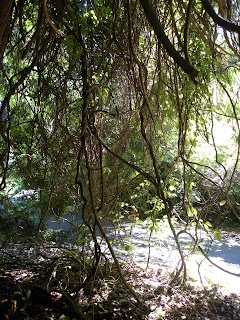 |
| Looking out from under a vine covered tree |
I also saw some very unique and interesting trees, stumps and burls. I have long been interested in these "character" trees and some of these inspired me to start a series of paintings that I call "Natures Gargoyles".
 |
| A gnarled tree nearby |
 |
| A very interesting Redcedar tree trunk |
 |
| Same tree, different angle, it looks a little like a rhinoceros to me |
Each work In my "Nature's Gargoyles"series is an ink and watercolour painting of a real tree, stump or burl that I have seen in the park or forest. These, along with paintings of flowers, angels, cats and a doorknocker, will be on display at Curve Point Grey as my art continues until the end of September. Each is 8 X 10.5 inches matted and in a mounted in a 14" X 18" black metal frame.
Curves (www.curveslocal.com/882 ) Point Grey, is located at 2570 Tolmie Street (at 10th). Curves is a women's fitness facility with a wonderful sense of community. The art displays change monthly, and while the art is usually for sale, the purpose is to add colour and interest to the facility. Visitors are welcome to come and see the art: women are welcome at any time (hours of operation), and men should phone and inquire about the best time for a visit. The closest BLine (to UBC) bus stop is Sasamat (then just a one block walk).
Here then are four of the paintings in my "Natures Gargoyles" collection:
The first "Old Stogie" reminded me of an old fellow with a cigar at the corner of its' mouth.
The first "Old Stogie" reminded me of an old fellow with a cigar at the corner of its' mouth.

This one is an overgrown stump, but to me looks so turtle like so I called the work "Old Leatherback". It is close to the edge of a path that I run and walk on so I visit the spot regularly.

The "Urban Wolf" below is an actual stump in the park near Jericho Beach in Vancouver. It reminds me of a wolf with its' head back howling.

This painting is of a "burl" about 15 feet up the trunk of an evergreen tree, a hemlock, I think. It looks so much like and elephant to me that I called it "Elephantine Trunk".

Here is the new addition to my "Thought for Food" series. Once again it is a watercolour, this time the subject is heritage tomatoes; I call this one "Heritage Colour".
Each of the cards in this series includes a recipe card (4.5" X 5") insert; "Heritage Colour" includes a recipe for "Tomato, Bocconcini Stacks".

The “Food for Thought’ series features paintings of fresh ingredients in a 5” x 5” card format (or prints if you prefer in choice of 4"X4" or 8" X 8"); each card contains an insert (5” x 4.5”) with a recipe using the featured ingredient. See all the images at www.pswhimsy.com I do the art for these cards and my husband, the chef in the family, offers a recipe suggestion.
As always, thank you for visiting my blog, and happy Whimsy Wednesday,


