Showing posts with label hummingbirds. Show all posts

Wednesday, 20 June 2012

Humming right along


Humming right along of course refers to hummingbirds. They are so small, so fast and magical to me.

"Hummingbirds are birds that comprise the family Trochilidae. They are among the smallest of birds, most species measuring in the 7.5–13 cm (3–5 in) range. Indeed, the smallest extant bird species is a hummingbird, the 5-cm Bee Hummingbird. They can hover in mid-air by rapidly flapping their wings 12–80 times per second (depending on the species). As well to conserve energy while they sleep or when food is scarce, they have the ability to go into a hibernation-like state (torpor) where their metabolic rate is slowed to 1/15th of its normal rate. They are also the only group of birds able to fly backwards. Their English name derives from the characteristic rapid wing beats. They can fly at speeds exceeding 15 m/s (54 km/h; 34 mph)." (Wikipedia)
These are the hummingbirds that visit my feeders. There are two Anna's Hummingbirds that stay all year round, in the early summer that number increases and Rufus Hummingbirds also join the group.


Rufus Hummingbird


Hummingbirds drink nectar from flowers, and sugar water from feeders, but they also eat insects and spiders. The nectar is a source of carbohydrate but not much else, it is from the insects and spiders that they get protein, vitamins and other nutrients that they need.

I think this one has just had a bath

Here are two videos I took the first video is a Rufus Hummingbird and the second is an Anna's Hummingbird.


At this time of year there are many flowers to supply the nectar that the hummingbirds use for energy and they usually only visit the feeders in the morning and evening, maybe for a burst of energy.


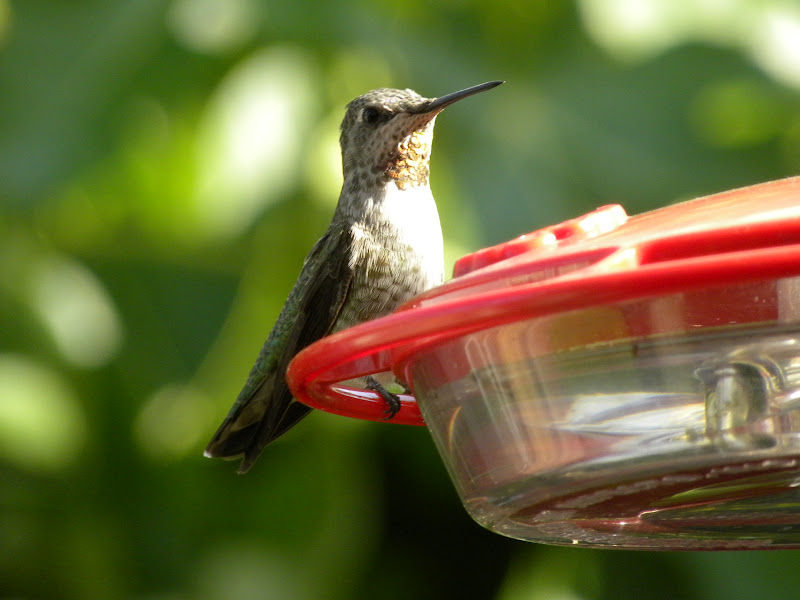


The throat and head colouring on these birds is often quite intense, you will notice this especially in the last few pictures in this series. Here is an explanation of that burst of colour:
 "Many of the Hummingbird species have bright plumage with exotic colouration. In many species, the coloring does not come from pigmentation in the feather structure, but instead from prism-like cells within the top layers of the feathers. When light hits these cells, it is split into wavelengths that reflect to the observer in varying degrees of intensity. The Hummingbird feather structure acts as a diffraction grating. The result is that, merely by shifting position, a muted-looking bird will suddenly become fiery red or vivid green.[31] However, not all hummingbird colors are due to the prism feather structure. The rusty browns of Allen's and Rufus Hummingbirds come from pigmentation. Iridescent hummingbird colors actually result from a combination of refraction and pigmentation, since the diffraction structures themselves are made of melanin, a pigment." (Wikipedia)


Even though they are very small, you will soon know if you have intruded into their territory. They make a sharp noise and will fly right up and confront they intruder, whether that is the person who fills the feeder or another hummingbird.

The territorial displays and aerial "battles" are quite amazing to watch. They only time that I have seen them share the feeder is late in the evening, when perhaps territory takes a back seat to survival.

A lot of spunk for such a small bird, and they add magic to my world.

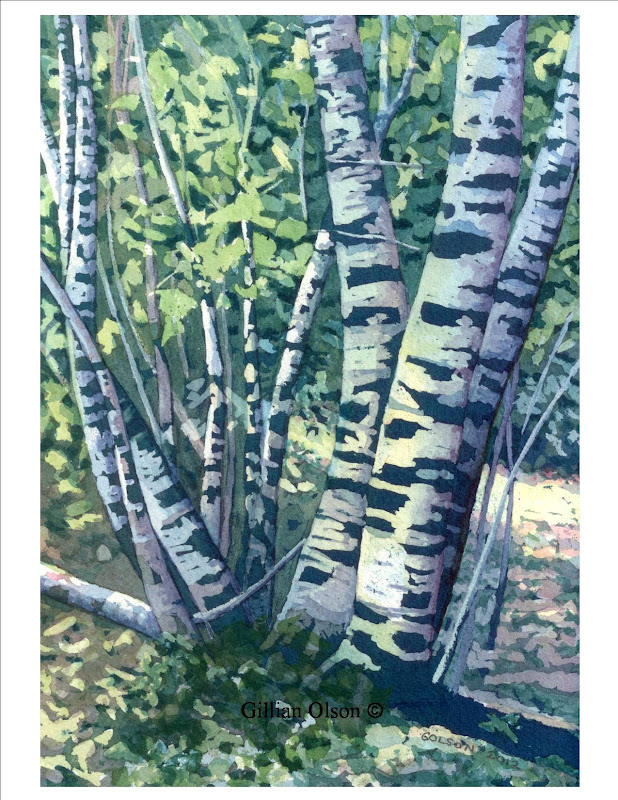
Here is another recent watercolour called "Forest Refuge". It is also one I am donating to the Brock House Summer Fair (more on that later).


Thanks again for dropping by, happy Whimsy Wednesday, until next week ....

Wednesday, 15 February 2012

Little Friends


Male Bushtit

"A bird does not sing because it has an answer. It sings because it has a song." Chinese Proverb

Female Bushtit

I recently put up some bird feeders outside my studio window. The Bushtits were the first to discover this new bounty, (I have feeders in other locations in the garden) and entertained me as I was working, with their jumping around and tweeting.

The Bushtit (Psaltriparus minimus) is a long tailed tit, and is the smallest of the passerines in North America. It is about 11 cm in length and weighs just over 5 grams.  Bushtits are a rather dull gray brown colour, with a large head and short stubby bill, short neck and long tail. The male has dark eyes and the adult female has yellow eyes.

They fly around in groups of 2 to 3 dozen (or more) and feed on insects and spiders but also eat the suet, seeds and nuts in my feeders. The flocks are quite comical to watch, they have an odd jumpy pattern of flying, when they are feeding in a tree or feeder they hop about in every direction. They constantly call out to to each other with a short "tsit" call.

I was watching as they went and grabbed nuts from the feeder in their beaks, flew to a perch and transferred the nut to their foot to eat it.

A female with piece of peanut


Male Bushtit (top) with dark eyes on the suet block


They crowd onto the suet feeder, I sometimes think they look like a pincushion with their tails sticking out in every direction.


The Bushtits share the feeder with Chickadees, Sparrows, Towhees, Juncos, Goldfinches, Starlings, Downy Woodpeckers and Red Shafted Flickers. The Crows and Squirrels (black and gray) also come by for a meal.


Staying with the bird theme here are some pictures of an albino hummingbird. I did not take them they were taken by Marlin Shank (but they were so beautiful I wanted to share them with you):

Fifteen-year-old photographer Marlin Shank was fortunate enough to capture 
several images of a rare albino ruby-throated hummingbird while in a park in 
Staunton , Va


You can click on any of the photographs to enlarge them, if you do so for the last one you will be able to see the ring of feathers surrounding the eye. They are amazing birds.

It has been a busy week for me and my sisters. My Mum is finally ready to leave hospital later this week after a fall causing a compression fracture in her lower back; she now needs more care than before so we have been struggling to find a safe but welcoming environment for her but one that offers her the support she now needs. I have my fingers crossed that we have found somewhere with a good balance.


One last bird shot in honour of Valentine's Day: a pair of Parrots happily sharing each others company.


"Birds on the Wires":


 Thank you for dropping by and Happy Whimsy Wednesday. Until next week......

Wednesday, 1 February 2012

For the birds

"For the birds" is an expression that usually means something is worthless. The expression is thought to originate from before the automotive age in New York city when horse drawn carriages were used for transportation and the horses left behind their "calling cards" in the streets. The horse droppings, or the undigested oats in them, attracted a large population of sparrows. So saying that something is "for the birds" is not a compliment although the birds seemed happy to have it.

When I said the expression "usually" means something is worthless, I did so because I intend no such slur against birds here today. To me watching birds is a joy and definitely not useless or worthless. 


The weather lately has not been pleasant, a lot of rain and wind and some snow. So on a rare sunny afternoon I eagerly grabbed my camera and headed out.

The birds were taking advantage of the day. There were about a dozen Robins, like the one above, feasting on red berries. These are North American Robins, which much bigger than their European cousins. The North American Robin belongs to the thrush family.

At first they watched me and then went back to the berries.


When I hear the saying "The early bird catches the worm" I always think of the Robin. This phrase is first recorded in John Ray's "A Collection of English Proverbs" (17th C) as "The early bird catcheth the worm" and is generally thought to mean that those who prepare well will be rewarded with success.

I continued my walk into the park. When I got to pond, it was partially covered in ice, but the ducks had managed to keep some open water. This pair of Mallards came over to see if I had anything good to offer and were disappointed when I didn't. There is a sign asking people not to feed the birds.


There was quite a commotion over the other side of the pond, and it seemed that there was a group "bird bath" happening. It was not just a couple of flaps it went on for over 10 minutes and was quite entertaining to watch. Apparently it was "spa day" at the pond.


Afterwards there was a lot of preening and feather arranging and I found this downy feather nearby.


I noticed this pair of Crows on the beach, I think this is the same pair that I have seen preening each other. They were standing a couple of feet apart and I asked them to get a little cozier so I could get a better "couple shot" and to my astonishment they almost immediately moved closer together and gave me the "is this OK now look". You might notice a bit of snow/frost in places on the beach too.


Here is the last of the "birds" for today, a short video titled "Pigeons - short animation cartoon":


On another topic, and nothing to do with birds, I would like to tell you about a fantastic play that we attended recently. "Duet for One" by Tom Kempinski is about the interaction between a violinist who has become unable to play after contracting MS and a psychiatrist.  The action takes place during a series of appointments in the psychiatrist's home office as the tangled emotions of the violinist are explored.  The dialogue between the two is powerfully compelling and the acting first rate.  It is part of the United Players current season at the Jericho Arts Centre until February 12, 2012 and is well worth seeing.

Lastly, I am taking a painting course, this one on "pouring watercolour". In this technique we prepare small containers of each of the primary colours and pour them onto our paper and use various techniques to move the colours around (using fingers, brush and blowing) then allow paint to dry. The pour below was for a picture of grapes.


Using the colours and shapes from the pour, here is the finished picture:

The next project is poured and will be a painting of poppies soon, I hope. The blank areas were masked and will become the foreground poppies, the poured areas will be the background. Please excuse the ugly green tape, it just holds the paper to my painting board and produces a clean border when removed.


This great course is taught by Leslie Redhead. Here is the link to her website: Leslie Redhead Watercolours

Thanks for your visit today, until next week, Happy Whimsy Wednesday.