Showing posts with label eagles. Show all posts

Wednesday, 31 August 2016

A few birds late on a Wednesday?

Apologies for my recent absence from blogging but I have been really busy painting. I have a show that goes up at the end of this week. Here is a sneak preview of one of my new paintings. It is a varnished watercolour, 24" X 18" and is called "Memories of Skedans 1":


More about that later in this post, first here are some photographs I took of birds while visiting Haida Gwaii early this summer and a story of a crafty raven.
 
 
I expected to see eagles, but was surprised at the number I saw. These two seen at Port Clements:


This one looking out over East Beach:

 
These near Masset:
The eagle in the background is either an immature or a golden eagle.

 
The last three were sighted near Skitigate: 


I had hundreds of pictures of eagles, this is just a small sample.
 
A gull, there were many but I was concentrating on other birds.

 
A crow, judging by the size, but what long legs............


This is a Pigeon Guillemot. A new bird for me, and a member of the Auk family of birds.

 
Look at those red orange feet! The inside of the beak and throat are the same bright colour.
 
 
Well I promised a raven story. I was sitting watching the world go by on the beach that leads to Rose Spit at the North end of Graham Island. There was a family a short distance away that had just finished a picnic and had left their bags and were strolling on the beach.

 
I noticed a raven land and watched as it surveyed the area, I thought it was looking for scraps.
 
Notice the bag on the log; the bird landed next to it and poked at the bag and pulled out a package. Apparently there was one wiener left in the package, after a short struggle the raven had its prize! 

 
Here are pictures of it flying off:


A raven landing in a strong wind:
 
 
Hi handsome!
 
 
A Plover: 


Sandpipers strutting their stuff:


More sandpipers: 


A Sandhill Crane:
 
 
And lastly, for today, a swallow:


I  mentioned earlier that I had been busy painting. Here are a couple more new works from my studio:
 
First "Haida Song", 18" X 24", varnished watercolour:
 
 
And last one for today is "Sticks and Stones 1", 9" X 12", varnished watercolour.


 These three paintings are part of my exhibit at the North Shore Unitarian Church in West Vancouver: (370 Mathers Avenue).
 
 
You can preview all the paintings in the show at:


Thanks for dropping by, until next time, happy Wednesday (a little late in the day),
 
Gillian


Wednesday, 27 July 2016

Haida Gwaii

I have recently returned from visiting Haida Gwaii. We drove to Prince Rupert and took the 7 hour ferry ride across Hecate Strait to Skitigate. Here is some background on Haida Gwaii:


"Haida Gwaii (/ˈhdə ɡw/ HY-də-GWY; Haida: X̱aayda gwaay;[2] literally "Islands of the Haida people"),[3] formerly known as the Queen Charlotte Islands[4] and the Charlottes, is an archipelago on the North Coast of British Columbia, Canada. Approximately half of its population is of the Haida people.[5]

The islands are separated from the British Columbia mainland to the east by Hecate Strait. Vancouver Island lies to the south, across Queen Charlotte Sound, while the U.S. state of Alaska is to the north, across the disputed Dixon Entrance.

Haida Gwaii consists of two main islands: Graham Island in the north and Moresby Island in the south, along with approximately 150 smaller islands with a total landmass of 10,180 km2 (3,931 sq mi). Other major islands include Anthony, Langara, Louise, Lyell, Burnaby, and Kunghit Islands. A parallel name to "Queen Charlotte Islands" used by American traders, who frequented the islands in the days of the marine fur trade and considered the islands part of the US-claimed Oregon Country, was Washington's Isles.[4][6][7]

Some of the islands are protected under federal legislation as Gwaii Haanas National Park Reserve and Haida Heritage Site, which is mostly Moresby Island (Gwaii Haanas in Haida) and adjoining islands and islets. Also protected, but under provincial legislation, are several provincial parks, the largest of which is Naikoon Provincial Park on northeastern Graham Island. The islands are home to an abundance of wildlife, including the largest subspecies of black bear, and also the smallest subspecies (Ursus americanus carlottae) and the subspecies of stoat Mustela erminea haidarum. Black-tailed deer and raccoon are introduced species that have become abundant.

On June 3, 2010, the Haida Gwaii Reconciliation Act officially renamed the islands Haida Gwaii as part of a reconciliation protocol between British Columbia and the Haida people." Wikipedia


It was my first visit, but I suspect I will return. I took 2500 pictures, I will share only a few today.

We spent most of our time on Graham Island near Tlell.

It is a green paradise....


...and a beachcombers delight.


here are few of the rocks I collected. Some of these rocks are layered mudstone and from the side resemble licorice allsorts.
 
I will share some shells in future posts.
 
 
Birds and berries.


We went on a few hikes, this one to the Pesuta.


Here is an "American Gothic" picture of my sister and me.
 

Forest creatures, an elephant? (spotted near Tow Hill)

 
A Haida canoe outside the museum in Skidigate.
 
 
Nootka  rose

 
Fresh chanterelles we collected.


 Fresh thimbleberry and salmonberry scones:
Yes homemade.


Haida Gwaii, a beautiful place and  justifiably proud people.


 -------------------------------------------------
 
Art news:
 
I received a third place award at the Arts 2016 show for my painting Venetian White. The exhibit continues until August 27, 2016 at the Surrey Art Gallery.

Here is the last painting I completed before my trip, a varnished watercolour named "Heart of Gold":


 Well that is all for today,

happy Wednesday, with whimsy,

Gillian.


Wednesday, 27 March 2013

Soaring ..

As I walked back along the shore last week I noticed several eagles high in the trees. Most were juveniles (dark heads) but there were also a pair of mature bald Eagles.


There is a new eagle nest platform in a Douglas Fir tree close to the Jericho Sailing Centre and the Vancouver Hostel. (See link to eagles' nests in Vancouver a little further down this post.)


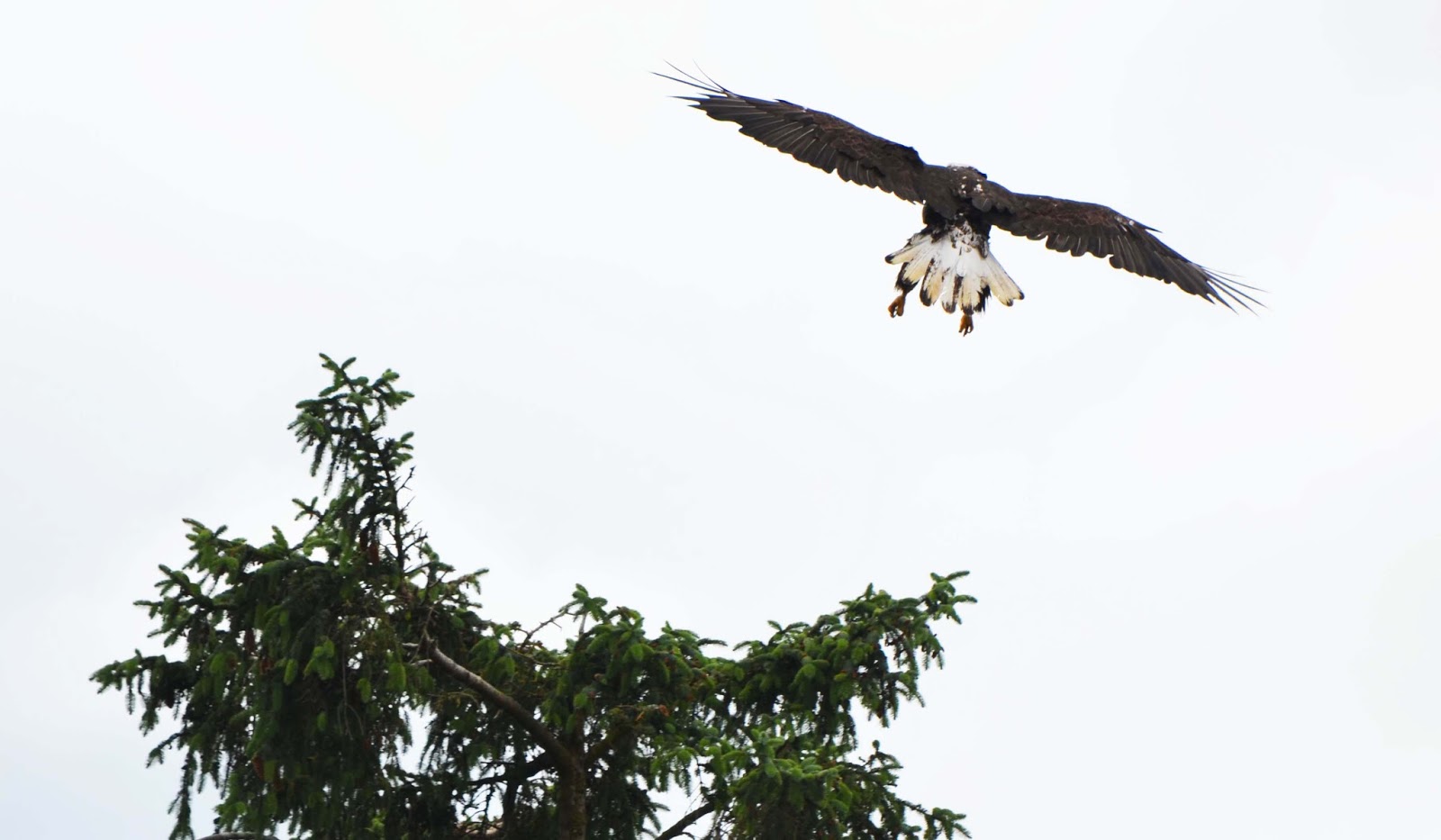
I saw a pair of eagles soaring above it and later one landed in the top of the tree.


Beautiful creatures to watch. Eagles have been nesting in the area (same pair ?) for a number of years but there have been at least two incidents (that I know of) of the nest collapsing and the eaglet falling and being taken to OWL (Orphaned Wildlife Rehabilitation Centre). 


There are quite a number of eagles nests in the Vancouver area, see this link.


There are a number of "eagle cams" in the area too that stream live coverage, here is a link to one of them.

Bald Eagles are magnificent birds, large and powerful, and did you know that the females are larger than the males? Here is short bio of our "bald" friends:

"Bald Eagles are so named because they are "white-headed". Balde is an Old English term meaning white.
Adult males and females are identical in color... white heads and tails, with blackish-brown bodies. Their feet and beaks are yellow.

Eagles mature at about 4 or 5 years of age, and live to about 30.
With up to a 7-foot wingspan, having a height of 3 to 3 1/2 feet, and weighing 8 to 15 pounds, these great birds of prey can lift about 4 pounds. The female is larger than the male.
An eagle's diet consists primarily of fish, but circumstance can force them to dine on carrion.
These 'eagle-eyed' birds have exemplary eyesight, and are strong swimmers.
Eagle pairs remain together until they are parted by the death of one of them.
Eaglets have all their feathers by 10 to 12 weeks of age. At this time, they are nearly full grown and can make maiden flights from their nest.
Juvenile eagles are a mixture of brown and white, becoming almost solid brown as they progress to adulthood.
Nests (aeries) are usually constructed in tall trees beside rivers or near coastlines.
Bald eagle nests are added to every year. They often become the largest of any bird in North America.
Bald eagles lay from one to three eggs each year, with two being the norm.
Kept warm by both parents alternating incubation duties, eaglets hatch in 35 days.
From the time the parents ready the aerie and the young are on their own (the nesting cycle), takes about 20 weeks." (www.jiwiz.com)


So are the little eagles just clumsy, why do they fall out of the nest? Well as they mature and get ready to take flight they practice by hanging on to a branch or part of the nest with their talons and flapping their wings as hard as they can; this is rather hard on the nest and can cause it to become unstable.


March/April is the beginning of the nesting season for the bald eagle in Vancouver. The pair of eagles I saw in Jericho Park do not seem to have started building a nest yet but I will be watching closely.

So what have I been up to in the studio?

First I have donated the following painting to the Curves Food bank drive, there is a silent auction on until the end of the month, if you wish to bid on it call or visit, here is the link. Last time I checked the bidding was at $55.

"Bleeding Hearts", watercolour, 8.5" X 6.5"


Here is a new watercolour in the seaside theme:

And yes, some barnacles  here grow quite large. These were inspired by a photograph taken on Cortez Island, B.C.

For more information on this or other works follow this link: GillianOlsonArt.blogspot.com

Well that's it for this week, thanks for dropping by, Happy Whimsy Wednesday, I will leave you with this thought: 
"Great men are like eagles, and build their nest on some lofty solitude."
Arthur Schopenhauer
Until next time .........................