Wednesday, 19 December 2012

Towhees the week before Christmas

Please excuse the play on "Twas the night before Christmas", I couldn't resist.

Beautiful natural colour inside and out these days. Inside the seasonal poinsettia, Christmas cactus, Amaryllis and Orchids and outside the show offs at the feeders. First the birds .......

I have been watching the Towhees recently, shy birds usually, but they have become more bold recently.

This is one of the Towhees (Rufus sided) that have been enjoying the nut feeder that I have recently purchased.


Bright red eyes,


Rufus sides,


and white under feathers on tail.


Here being showed off for the camera in an action shot.


Another look at those sides .............


Aren't I a looker?


Well aren't I!


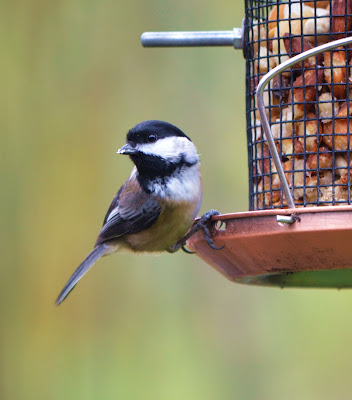
Chickadees are fun to watch too.


Not quite as colourful, but lots of personality:


Getting quite chubby too!


Maybe a bit large for this feeder, and house lady take notice this feeder needs filling.


A bit blurry, but this is a shot of the hummingbird just before it buzzed me.


Christmas cactus, almost waiting until Christmas to flower.


Orchids are a year round favorite of mine.


And of course the seasonal Poinsettias.


And here is a painting that I have finished recently. It is a watercolour painting of scene from the Umbria region of Italy.


Best wishes to you all for peace, joy, friendship and good health,

Happy Whimsy Wednesday, until next week ..........................

Wednesday, 12 December 2012

Time to get cracking?

Well it is starting to look and sound like Christmas, so I thought I would explore a Christmas tradition.

Nutcrackers are a a favorite Christmas decoration, the Nutcracker Suite is often performed at this time of year; where and when did this tradition start?


 "Nutcrackers in the form of wooden carvings of a soldier, knight, king, or other profession have existed since at least the 15th century. These nutcrackers portray a person with a large mouth which the operator opens by lifting a lever in the back of the figurine. Originally one could insert a nut in the big-toothed mouth, press down and thereby crack the nut. Modern nutcrackers in this style serve mostly for decoration, mainly at Christmas time. The ballet The Nutcracker derives its name from this festive holiday decoration. Nutcrackers have long been a traditional symbol of Christmas. The original nutcrackers were first seen in Germany and were thought to have guardian-like properties because of their strong appearance."


 I have visited the Nutcracker museum in Leavenworth, Washington; a place filled with Nutcrackers of all sizes and styles.


 "The carving of nutcrackers—as well as of religious figures and of cribs—developed as a cottage industry in forested rural areas of Germany. The most famous nutcracker carvings come from Sonneberg in Thuringia (also a center of dollmaking) and from the Ore Mountains. Wood-carving usually provided the only income for the people living there. Today the travel industry supplements their income by bringing visitors to the remote areas."


"While the first nutcrackers were produced to more effectively and efficiently crack nuts, the first German nutcrackers as decorative pieces were developed somewhere between the late 1400s and early 1500s. Many of these early German nutcracker designs were in the shapes of animals, birds, and people."

"It was not until the late 1600s and early 1700s that German nutcrackers took on the personas of the kings, soldiers, church leaders, and policemen. As miners and villagers of the Erzgebirge region improved their carving and crafting skills, the German nutcrackers began developing into popular collectible pieces around the region and throughout Germany." 
"People enjoyed using the German nutcrackers that were shaped like the ruling and authoritative classes because it reduced them to the position of mere crackers of nuts rather than possessing any power over their individual freedoms." (www.christkindl-markt.com)


Nut crackers come in all shapes and sizes.


So how well do they work? This kind is quite effective.


This nutcracker works by rotating the device once the nut is inserted, interesting idea but not as effective as more traditional designs.


The nutcracker is more for decoration than function, I was not able to get it to work on a nut and didn't want to break it (the nutcracker not the nut).


This little nutcracker is way too small to be of use as a nutcracker.


Of course this method is quite effective, albeit a bit messy:


This is maybe a very early nutcracker, and still very effective too!


Nuts were a seasonal favorite when I was a kid. Mandarin oranges, whole nuts and pomegranates were Christmas season treats and still signal Christmas to me.


This week I painted a scene from a town in southern Italy. Several years ago we visited Puglia and while there visited the town of Alberobello, a small town in the province of Bari, which is famous for its trullo (plural trulli) houses.

Alberobella is a world heritage site famous for its trulli houses, which are built of stone without using mortar, the stones are just laid on top on one another. They are characterized by dome shaped roofs which are sometimes painted with pagan symbols.

The home could easily be disassembled for moving, also it is said that they could be disassembled to avoid paying taxes.

We visited on a bright sunny day, and it was both a beautiful site and a beautiful sight. This is a watercolour that I think I might call "Trulli Beautiful".


Well that's all for this week,  thanks for dropping by, happy Whimsy Wednesday, until next week ...........


Wednesday, 5 December 2012

The dark days are murder............

As the days get shorter, I find my energy level waning. Many suffer this time of year from seasonal affective disorder due to the low light and short days, me among them.

``Seasonal affective disorder (SAD), also known as winter depression, winter blues, summer depression, summer blues, or seasonal depression, is a mood disorder in which people who have normal mental health throughout most of the year experience depressive symptoms in the winter or summer, spring or autumn year after year.`` (Wikipedia)

 This time of year hibernation seems like a great idea; I think that nature intends us to get more rest and take it easy this time of year. But with the Christmas season fast approaching how is that possible? Instead, I'll have to get as much outside time as the weather permits, I find this helps me, and take some extra vitamin D (the sunshine vitamin); it is only another three weeks until the days start getting longer.............

Speaking of murder, it is also a collective noun for a group of crows.


Crows are members of the  family Corvidae, forming the genus Corvus.

``The crow genus makes up a third of the species in the Corvidae family. Crows appear to have evolved in Asia from the corvid stock, which had evolved in Australia. The collective name for a group of crows is a flock or, more poetically, a murder.`` (Wikipedia)


Crows are very smart birds, they seem to recognize faces, so if you slight them in some way they will remember. I heard a story about a man who found a dead crow on his property, he picked it up and threw it in the garbage can. Not a crow friendly act, because for a long while afterwards whenever he ventured out of the house the crows would dive bomb him, they did not threaten anyone else coming or going from the house  or in the neighbourhood.

``Recent research has found some crow species capable not only of tool use but of tool construction as well. Crows are now considered to be among the world's most intelligent animals. The Jackdaw and the European Magpie have been found to have a nidopallium approximately the same relative size as the functionally equivalent neocortex in chimpanzees and humans, and significantly larger than is found in the gibbon.`` (Wikipedia)


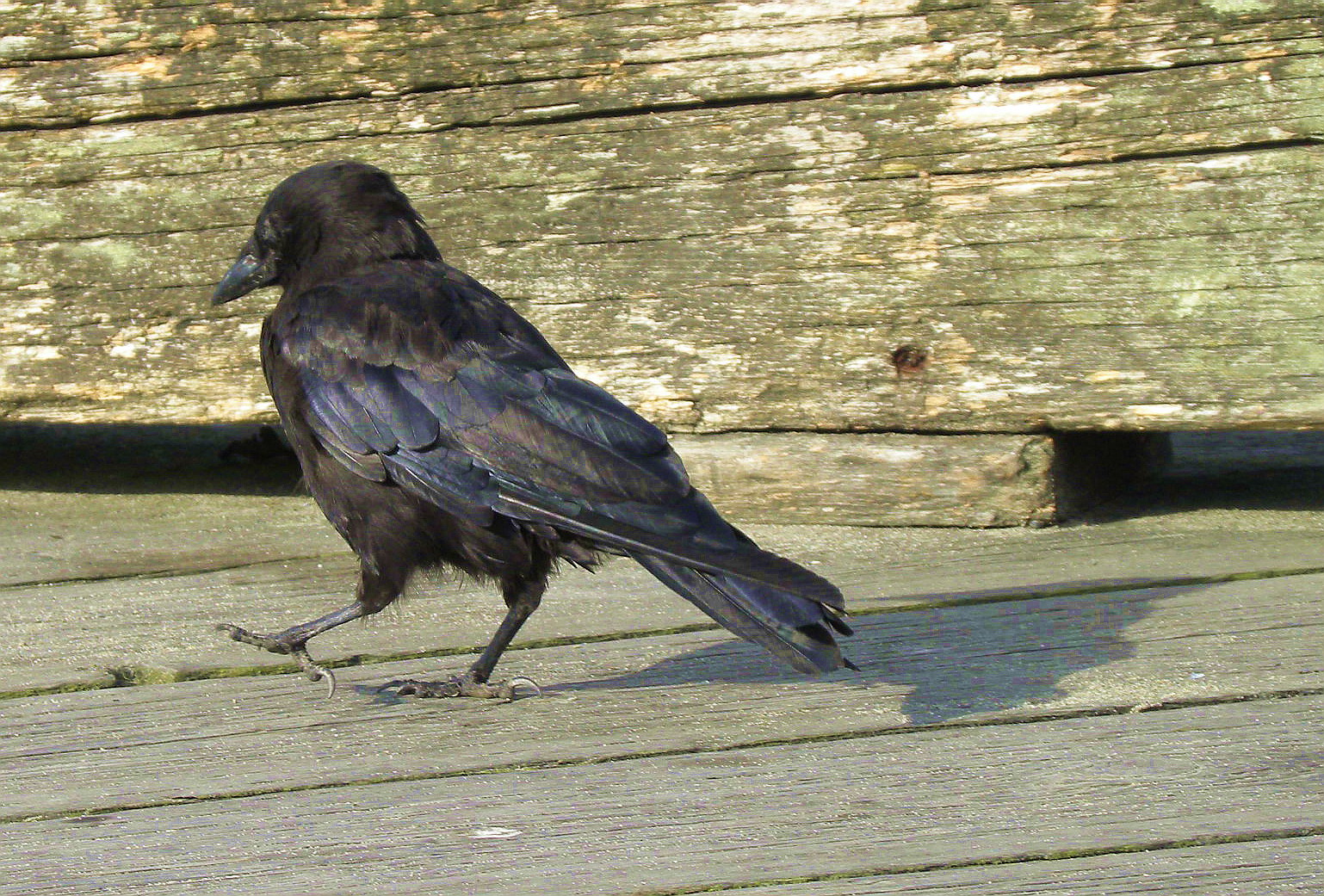
This one is goose stepping down a local dock.


They watch what is going on carefully.


Always alert for a tasty morsel.


At my house the crows rob the suet feeder: it doesn`t seem to matter how I try to secure it so that only the small birds can approach it the crows are up to the challenge (You can see suet on the end of this crow's beak).


Anyone feeding the rabbits in the local park also supplements the crows diet. They seem to have a great sense of timing, showing up just as the meal is being delivered.


Here the rabbit is waiting for the crows to finish, but neither seems worried about the others presence.


I watched a crow in a parking lot in the Grand Canyon: each new car that parked was checked out by the crow who cleaned up all the freshly squashed bugs on the front grill of each one. It was facsinating, the crow seemed to know which order the cars came in and ``attended`` to them accordingly.


These pictures were taken close to the beach, a source of mussels and other shells, which the crows drop
onto the road to open; if that doesn`t work they seem to drop them in the path of an oncoming car, hoping the car wheels will free the tasty morsel inside.


A young crow (I think) doing some grooming:


At the end of the day, unless they are nesting, the crows head to one of several large roosts for the night. On a summer evening  I have watched hundreds fly past as the light starts to wane.

Crows do not like eagles or hawks in their territory, as a group, or murder, they chase the raptor mercilessly usually resulting in the raptor leaving the area.

Fascinating birds!

A painted a bird this week, but sad to say not a crow. This is a watercolour of a house finch called "Winter Colour":


That's it for this week, thank you for dropping by, happy Whimsy Wednesday, until next week ................