Wednesday, 24 October 2012

Chasing Rainbows

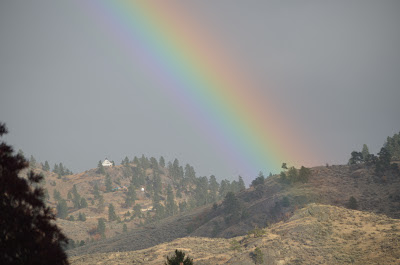
Chasing rainbows generally refers to trying to achieve something that is not possible or practical. About a week ago I was away in the Okanagan Valley for a break and to see the harvest (more on that next post) and  while there experienced some amazing rainbows.

The Valley had not had rain for 9 or 10 weeks, allowing for ripening and harvesting of fruit, vegetables, nuts and grapes. So when some storms brought rain (and rainbows) no one seemed to be complaining.

In the first picture I managed to capture two small planes as well:


I photographed two rainbows, the first seemed to shine right down on an orchard, and lit up the surrounding area.


Dreaming of Rainbows

"A rainbow is an optical and meteorological phenomenon that is caused by reflection of light in water droplets in the Earth's atmosphere, resulting in a spectrum of light appearing in the sky. It takes the form of a multicoloured arc."
"Rainbows caused by sunlight always appear in the section of sky directly opposite the sun.
In a "primary rainbow", the arc shows red on the outer part and violet on the inner side. This rainbow is caused by light being refracted while entering a droplet of water, then reflected inside on the back of the droplet and refracted again when leaving it."
"In a double rainbow, a second arc is seen outside the primary arc, and has the order of its colours reversed, red facing toward the other one, in both rainbows. This second rainbow is caused by light reflecting twice inside water droplets." (Wikipedia)

I did not see a double rainbow but here is the second rainbow, from much later in the day.


"The rainbow is not located at a specific distance, but comes from any water droplets viewed from a certain angle relative to the Sun's rays. Thus, a rainbow is not an object, and cannot be physically approached. Indeed, it is impossible for an observer to manoeuvre to see any rainbow from water droplets at any angle other than the customary one of 42 degrees from the direction opposite the Sun. Even if an observer sees another observer who seems "under" or "at the end" of a rainbow, the second observer will see a different rainbow further off-yet, at the same angle as seen by the first observer. 
A rainbow spans a continuous spectrum of colours. Any distinct bands perceived are an artifact of human colour vision, and no banding of any type is seen in a black-and-white photo of a rainbow, only a smooth gradation of intensity to a maximum, then fading towards the other side. For colours seen by a normal human eye, the most commonly cited and remembered sequence is Newton's seven fold red, orange, yellow, green, blue, indigo and violet."
"Rainbows can be caused by many forms of airborne water. These include not only rain, but also mist, spray, and airborne dew." (Wikipedia)

This one seems to rest on the top of a hill.


Then slides down into the valley.


Just after the rainbow was gone:


So apparently one can't actually catch or find the end of a rainbow, well that won't stop me from trying.

Here is "Somewhere over the rainbow" sung by Judy Garland


This little lady followed me as I was taking pictures; I think she thought I had a treats for her, or maybe she was following a rainbow of her own.


The late afternoon light after the rainbows was beautiful.


Here is a little something for Master E and his Grandmama, both faithful followers of my blog. Master E had a severe respiratory infection and spent a few days in hospital last week. He is home now though and getting better with each day.  He requested a video, so here is a chickadee:


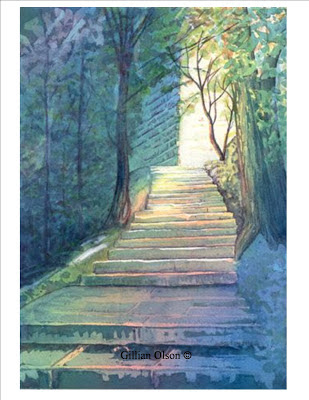
I have been away quite a bit lately and although I have started quite a few painting projects, I haven't finished any so I thought that I would share one of my favorites from a few months ago. This is "Path of Light" and it seems to me it contains all the colours of the rainbow:

  
This is a watercolour of a pathway that I photographed while in Italy a few years ago.

Well that's all for this week, Happy Whimsy Wednesday, until next time .............


Monday, 22 October 2012

Leaves for Leontien

An Autumn event to show our support for fellow blogger and farm gal, Leontien, who is battling cancer.

Leaves for Leontien


From a A Rural Journey :


"October is National Breast Cancer Month.
With that in mind, I think it is an appropriate time to again show our fellow blogger and farm gal, Leontienhow much we care and are thinking of her and her awesome hubby, Bastiaan, during this difficult time.
Leontien is battling an aggressive form of melanoma (see an update to her status here,) and your support and continued participation in this new event would be very much appreciated."


The blogging community brings people together, we get to share experiences and laugh and cry with our blogging friends and they get to feel like a family. So when I heard about Leontien from A Rural Journey and Run*a*Round Ranch I wanted to add some leaves to the cause ...........

Leaves for Leontien with love ....


Wednesday, 17 October 2012

Sun worship?

Sunflowers are big showy blooms, seeing a large field of them is a memorable experience.


The flowers face in the same direction, east, as if worshiping the rising sun. It is a popular misconception that sunflowers move with the sun.

"A common misconception is that sunflower heads track the Sun across the sky.[8] This old and chronic misconception was debunked already in 1597 by the English botanist John Gerard, who grew sunflowers in his famous herbal garden: "[some] have reported it to turn with the Sun, the which I could never observe, although I have endeavored to find out the truth of it."[7] The uniform alignment of sunflower heads in a field might give some people the false impression that they are tracking the sun, but the heads are actually pointing in a fixed direction (East) all day long."
 "That is why blooming (and faded) flowers of the sunflower are living compasses (however not too exact): West is behind, North to the left, and South to the right. This is true for open space only." (Wikipedia)


A field of Sunflowers growing in France


"Sunflower (Helianthus annuus) is an annual plant native to the Americas. It possesses a large inflorescence (flowering head). The sunflower is named after its huge, fiery blooms, whose shape and image are often used to depict the sun. It has a rough, hairy stem, broad, coarsely toothed, rough leaves and circular heads of flowers. The heads consist of many individual flowers which mature into seeds, often in the hundreds, on a receptacle base."
"From the Americas, sunflower seeds were brought to Europe in the 16th century..." The plant was cultivated from the seeds .. "along with sunflower oil, they became a widespread cooking ingredient."
"Leaves of the sunflower can be used as cattle feed, while the stems contain a fibre which may be used in paper production." (Wikipedia)

Though the Sunflower starts as a smallish seed it can grow to be a giant. I think this is a much more appropriate plant for the "Jack in a bean stalk" story than a bean, but "Jack in the Sunflower" probably won't replace the classic.

The flower heads start out as a large tightly closed bud and slowly open to reveal first the petals and then the flowers.


The flowers are pollinated and form into seeds and the head becomes heavier and begins to droop.


The flowers and seeds form a spiral pattern, a form of Fermat's Spiral, and it turns out there is a bit of mathematical magic here:

Here is an excerpt from Wikipedia to explain:
Mathematical model of floret arrangement
Illustration of Vogel's model for n=1 ... 500

"A model for the pattern of florets in the head of a sunflower was proposed by H. Vogel in 1979. This is expressed in polar coordinates
r = c \sqrt{n},
\theta = n \times 137.5^{\circ},
where θ is the angle, r is the radius or distance from the center, and n is the index number of the floret and c is a constant scaling factor. It is a form of Fermat's spiral. The angle 137.5° is related to the golden ratio (55/144 of a circular angle, where 55 and 144 are Fibonacci numbers) and gives a close packing of florets. This model has been used to produce computer graphics representations of sunflowers."


This one appears to be shading its "face" from the sun:


"The evidence thus far is that the sunflower was first domesticated in what is now the southeastern US, roughly 5000 years ago.,[12] and possibly introduced into Mexico at an early date, as other crops such as maize were exchanged. The earliest known examples of a fully domesticated sunflower have been found in Tennessee, and date to around 2300 BC. Many indigenous American peoples used the sunflower as the symbol of their solar deity, including the Aztecs and the Otomi of Mexico and the Incas in South America. In 1510 early Spanish explorers encountered the sunflower in the Americas and carried its seeds back to Europe.[13] Of the four plants known to have been domesticated in what is now the continental United States (marshelder (Iva annua), chenopod (Chenopodium berlandieri), squash (Cucurbita pepo), and sunflower (Helianthus annuus)) to have become an important agricultural commodity, sunflower is currently the most economically important."
"During the 18th century, the use of sunflower oil became very popular in Russia, particularly with members of the Russian Orthodox Church, because sunflower oil was one of the few oils that was allowed during Lent, according to some fasting traditions." (Wikipedia)


Sunflowers are (from Wikipedia):

  • the state flower of the US state of Kansas, and one of the city flowers of KitakyÅ«shÅ«, Japan.
  • often used as a symbol of green ideology. The sunflower is also the symbol of the Vegan Society.
  • during the late 19th century, used as the symbol of the Aesthetic Movement.
  • the subject of Van Gogh's most famous series of paintings, Sunflowers (one version below)
  • the national flower of Ukraine.
  • chosen as the symbol of the Spiritualist Church for many reasons, but mostly because it turns toward the sun as "Spiritualism turns toward the light of truth". Modern Spiritualists often have art or jewelry with sunflower designs.
  • from February 2010, painted on part of  Kuban Airlines of Russia's fleet in a new livery featuring enormous flowers.


File:Vincent Willem van Gogh 128.jpg
one version of Vincent Van Gogh's Sunflowers series

I am painting a picture of sunflowers too, but I don't dare share the stage with Vincent, so I will show that another time.

Thank you for dropping by, a very happy Whimsy Wednesday to you, until next time .............

Wednesday, 10 October 2012

Seedy?

We celebrated the Thanksgiving Day weekend enjoying the beautiful sunny, warm Fall weather and hosting dinner for friends. A belated Happy Thanksgiving to my Canadian readers.

Maple samaras

Seedy has a few meanings.
To paraphrase Merriam Webster (Merriam Webster.com):
Seedy is an adjective, pronounced sÄ“-dÄ“, meaning
1) containing or full of seeds <a seedy fruit>
2) inferior in condition or quality: as (shabby, run-down <seedy clothes>), somewhat disreputable (<a seedy district> <a seedy lawyer>)
3) slightly unwell (debilitated <felt seedy and went home early>)


The "Online Etymology Dictionary" (© 2010 Douglas Harper) has this to say about the origin of "seedy":
"1440, "fruitful, abundant," from seed (n.). Meaning "shabby" is attested from 1739, probably in allusion to the appearance of a flowering plant that has run to seed."
But being "seedy" is the end of a successful cycle in the plant world. I find it interesting that something so positive botanically can come to mean almost the opposite in the non-plant world.


So today I am celebrating in pictures, a seedy and wonderful end for these plants:

Virginia Creeper with berries

Fuchsia with "berries"
?


Tomatillo


Clematis 
Berries, seeds, nuts, hips and samaras are the start and the end of the plant life cycle. Every year in my garden I have a number of plant "volunteers", plants that appear and which I have not seeded. They are seeds from a previous season or seeds that grow from the compost layer that I add to the soil. Among this years "volunteers" or "surprises" was a tomatillo plant.


Rose hips
"The rose hip, also known as rose haw or rose hep, is the fruit of the rose plant, that typically is red-to-orange, but ranges from dark purple to black in some species. Rose hips begin to form after successful pollination of flowers in spring or early summer, and ripen in late summer through autumn.
Rose hips are used for herbal tea, jam, jelly, syrup, soup, beverages, pies, bread, wine, and marmalade.  They can also be eaten raw, like a berry, if care is used to avoid the hairs inside the fruit." (Wikipedia)
One single late bloom on my clematis and seed heads.


Wispy clematis seeds


Late season strawberries

Hover fly visiting strawberries


Echinacea seed head
Asparagus "berries"


Not "seedy" yet but I couldn't resist this Tansy

Sweet peas and pea pod
Mature pods containing sweet pea seeds


I don't know what the small berries or seeds below are, similar to but much smaller than a horse chestnut pod.


Thistle down or thistle seeds


Lupin seeds


Lady bug on Echinacea seed head


Underside of fern showing seeds or spores

Blackberries

Thistles kissed by dew
Almonds

Seed head on Vicar's Mead

Salal Berries
Acorn
I thought this grass looked a lot like "sparklers" partly burned down.


Laitrus seeds

One thing is certain though, these creatures think "seedy" is a really good thing - it's their Thanksgiving feast.


I hope you have enjoyed my quirky look at "seedy".

Here is a painting that I finished this week, it is titled "Putting on a Show". It is a watercolour of a Hollyhock that I saw in rural France and photographed.


I had a bit of difficulty getting my husband to stop so that I could take some pictures of this flower, but I'm glad he did stop, I am really pleased with the painting.

Lastly, I apologize for being largely absent from blogland this past week, but I have been busy updating my website. I changed the content, the order, some of the names and the prices and I added a "New items and Specials" page to the gallery:
http://pswhimsy.myshopify.com/collections/new-items-and-specials/

I am glad you stopped by, I love your comments and feedback.

Happy Whimsy Wednesday, until next week ..............