Wednesday, 28 March 2012

Eye see


I had my first eye surgery (for cataracts) at the end of last week and I can see better out of my left eye now than I have for over 50 years. Yes, I have been very short sighted for a very long time, that is when you have difficulty seeing your hand in front of your face and don't even ask about the distance. My standard answer to someone who asks me how far down the eye chart can you read is, what chart? Even so, glasses and contact lens have allowed me to see quite well for most of that time.


I needed surgery because my eyesight had been deteriorating so quickly that practically speaking it was no longer correctable: by the time I got a new prescription filled my eyes were slipping again. So I was over the moon when I found out that there was not only an explantion but also a solution.


The first day after my surgery, I got up, took the protective patch off and I could see well enough
with the one eye to have my breakfast and read the newspaper without corrective lenses. I was thrilled. To top it off the day was bright and beautiful, so I put a contact lens in the other eye (better balance when both eyes see) and went out with my camera.


Everyone that I knew that had had cataract surgery said, you will be amazed, it is as if your colours come back. I thought that my colour perception was pretty good still, but the difference for me was light!


Yes light and depth,  things are definitely not just two dimensional any more, the shadows, the shapes, the perspective have all changed dramatically.

My walk took me to a nearby park, where I was overwhelmed by the beauty and light. In some ways it was as if I was seeing it for the first time.

The cherry trees were blooming and I took picture after picture of the blossoms and drank in the subtle perfume.


Here is a little background on what a cataract is from Wikipedia:

"Cataract surgery is the removal of the natural lens of the eye (also called "crystalline lens") that has developed an opacification, which is referred to as a cataract. Metabolic changes of the crystalline lens fibers over time lead to the development of the cataract and loss of transparency, causing impairment or loss of vision. Many patients' first symptoms are strong glare from lights and small light sources at night, along with reduced acuity at low light levels. During cataract surgery, a patient's cloudy natural lens is removed and replaced with a synthetic lens to restore the lens's transparency."

"Following surgical removal of the natural lens, an artificial intraocular lens implant is inserted (eye surgeons say that the lens is "implanted"). Cataract surgery is generally performed by an ophthalmologist (eye surgeon) in an ambulatory (rather than inpatient) setting, in a surgical center or hospital, using local anesthesia (either topical, peribulbar, or retrobulbar), usually causing little or no discomfort to the patient. Well over 90% of operations are successful in restoring useful vision, with a low complication rate. Day care, high volume, minimally invasive, small incision phacoemulsification with quick post-op recovery has become the standard of care in cataract surgery all over the world."

Here is my rather unscientific explanation of myopia, as I understand it when a person is myopic, or short sighted, the eyeball instead of being round is instead oblong, so when the light or image enters the eye it doesn't focus on the retina (the eye's "big screen" at the back) instead it focuses somewhere in front of it and things look blurry. This can be corrected with either glasses or contact lenses that are thinner in the middle, and thicker at the edges (think Coke bottle maybe) which lenghtens the focal length so the light or image reaches the retina, or close to it, an the image is sharper.

In cataract surgery since the natural lens is being replaced anyway it is an opportunity to replace it with one that also corrects vision. Yipee!

We have three fields of vision, close, middle and distance. When we get older most of us start having problems seeing closeup, and as a result wear glasses for close work or reading. When vision is corrected with a replacement lens, as I understand it, you can have your vision corrected for close and middle or for middle and distance. I have chosen to have one eye corrected for close and middle and the other for middle and distance and hope to be able to have the two work together to see almost everything clearly. That's the plan anyway.


So to get back to walking in the park, the trees, the blossoms, the birds it was wonderful to see things more clearly, and should be even better when my second eye surgery is complete.

Being very short sighted has another odd complication and that is that after one eye is corrected with an implanted lens the image size that I see with that eye is different than the size of the other eye with the contact lens on the surface of the eye. At first I wasn't walking in a straight line at all, but I am getting more used to the sensation; for this reason the surgeon tries to do the surgeries fairly close together.


Enough said? Come and enjoy the blossoms with me.


"You can become blind by seeing each day as a similar one. Each day is a different one, each day brings a miracle of its own. It's just a matter of paying attention to this miracle."
Paulo Coelho

Somehow I don't think I am going to take seeing well for granted, it is a wonderful gift and I am most grateful to have it.

I did manage to finish off the painting I started last week and I have been working on a couple of new ones. Here is the finished watercolour "Spring Tulips":

"Spring Tulips"

That's all for today, thanks for dropping by, Happy Whimsy Wednesday, until next week.............





Wednesday, 21 March 2012

Spring at last, a magic time!


Crocuses all in a row

Today I celebrate the arrival of Spring: spring sightings, magic and storytelling are on the agenda.

It is Spring at last; in fact today's Whimsy Wednesday is coming to you on the first full day of Spring. Spring officially started March 20 at 1:14 am EDT, this is called the Vernal Equinox (from "ver" meaning spring).

Forsythia

The start of Spring is marked by the equinox. Equinox is derived from a Latin word meaning "equal night", or equal daylight and night hours. The Spring and Fall equinoxes are the only dates of equal day and night and mark the time that the sun crosses the celestial equator, but it happens at a point in time and not actually on a particular "day". Here is an explanation from Wikipedia:
"At an equinox, the Sun is at one of two opposite points on the celestial sphere where the celestial equator (i.e. declination 0) and ecliptic intersect. These points of intersection are called equinoctial points: classically, the vernal point and the autumnal point. By extension, the term equinox may denote an equinoctial point.
An equinox happens each year at two specific moments in time (rather than two whole days), when there is a location (the subsolar point) on the Earth's equator, where the center of the Sun can be observed to be vertically overhead, occurring around March 20 and September 22 each year.
Although the word equinox is often understood to mean "equal [day and] night", this is not strictly true. For most locations on earth, there are two distinct identifiable days per year when the length of day and night are closest to being equal; those days are referred to as the "equiluxes" to distinguish them from the equinoxes. Equinoxes are points in time, but equiluxes are days. By convention, equiluxes are the days where sunrise and sunset are closest to being exactly 12 hours apart."

Spring flowers, warmer temperatures and longer daylight hours, bring it on. In the past few days I have noticed several people cutting their lawns, the smell of fresh cut grass brought memories of summer days rushing back to me.

Spring sights are all around me. There is new growth on the trees, a bright yellow green.


The Weeping Willows are budding, which makes them appear to be wearing lovely light yellow shawls draped over their branches. First a picture of the tree followed by detail of one of the branches.


Weeping Willow in bud

The perennials are starting to spout, the rhubarb is unfurling, the salmon berries have their first leaves and flowers and the pussy willows are popping open, these too are sure signs of Spring.

First Rhubarb shouts and leaves


Pussy Willows

And there are flowers. Colours popping up everywhere.


Cherry Blossoms


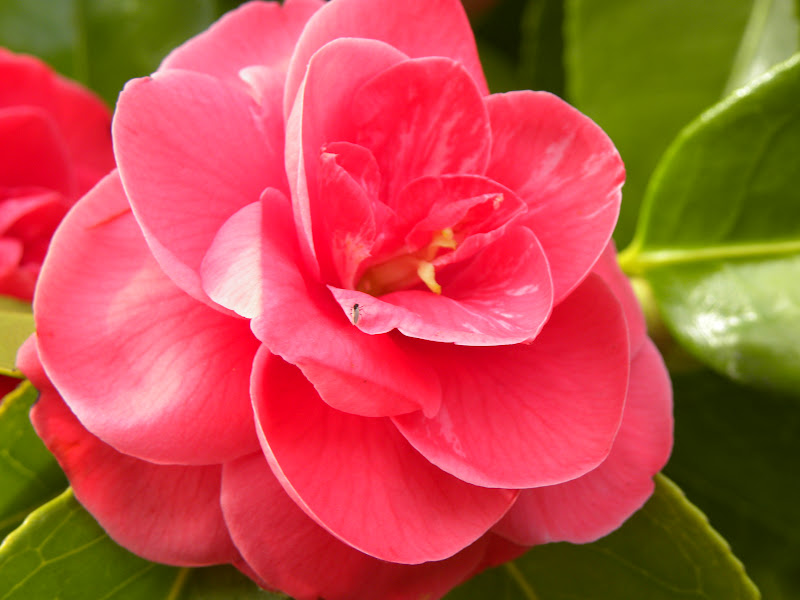
Camillia in bloom


Forsythia
Spring blooms in the park

Early daisies in the grass at the park

The birds are very busy eating, pairing off and getting ready to nest.


American Robin

Sparrows (above and below)


All this is happening at this time of year. But I referred to magic at the beginning of this post and that had to do with an egg. Here is a picture of a raw egg, balanced on its end. Why and how you may ask, well read on.


A raw egg balanced on my kitchen counter

According to folklore at the equinox it is possible to stand an egg on its end. Now this is something that I thought needed some investigation, and I do try to take my research seriously! So I have tried this out, starting on March 16, I was able to stand two different eggs (out of 5) on their ends, one stayed for about 20 minutes the other until the counter that it was standing on was jolted; sad story here, you remember the Humpty Dumpty tale, well Humpty ended up in the garbage after rolling to the edge of the kitchen counter and diving onto the kitchen floor.

I tried this out a few times and then on March 20, I was able to stand five eggs on end. I did not wait until the exact start of Spring, that being in the early morning hours here, a time meant for sleeping; after all we lost that hour last week with the change to DST. Spring magic or not here they are standing on end:


This may have nothing to do with the equinox but it I thought it made a good story and segue into the next topic.

The Spring equinox is also cause for celebration as "World Storytelling Day":

"World Storytelling Day, is a global celebration of the art of oral storytelling. It is celebrated every year on the spring equinox in the northern hemisphere, the first day of autumn equinox in the southern. On World Storytelling Day, as many people as possible tell and listen to stories in as many languages and at as many places as possible, during the same day and night. Participants tell each other about their events in order to share stories and inspiration, to learn from each other and create international contacts.
The significance in the event lies in the fact that it is the first global celebration of storytelling of its kind, and has been important in forging links between storytellers often working far apart from each other. It has also been significant in drawing public and media attention to storytelling as an art form." (Wikipedia)
At this point you will have to decide here whether I have been telling you a tale about the eggs or not.

Storytelling is a wonderful tradition, at times it seems to be a dying art form, so I was thrilled to discover that first there is a "World Storytelling Day" and second it is celebrated at the Spring Equinox.

As a blogger and a blog follower I delight in stories, I know that these are written and not oral, but I often feel I can "hear" the author telling me his/her story. On this first day of Spring, at the Vernal Equinox and on "World Storytelling Day" I want to thank all those who follow my blog, and thanks to all those wonderful bloggers out there whose blogs delight me daily.

So on this first day of Spring, take time to look at the flowers and watch the birds, tell someone a story and maybe even try to balance an egg. Oh-oh I see omelettes on the menu.

Here's a song to celebrate Spring: Morning has Broken - Cat Stephens


I have been busy painting again, this week flowers, in watercolour of course. I finished this one of tulips, called Pink Sunshine. I am almost finished another one of red tulips, but that will have to wait until next week.
Pink Sunshine


Happy Whimsy Wednesday, thanks for stopping by, until next week..............

Wednesday, 14 March 2012

Have you got the time?

My reliable Timex

Well, it is that time of the year again when we change our clocks to Daylight Saving Time (DST) or summer time, from Standard Time (ST). In doing this we gain more daylight in the evening but we lose an hour of sleep.

Why? Well good question.

According to Wikipedia:
"Though mentioned by Benjamin Franklin in 1784, the modern idea of daylight saving was first proposed in 1895 by George Vernon Hudson [8] and it was first implemented during the First World War. Many countries have used it at various times since then; details vary by location.
The practice has been both praised and criticized. Adding daylight to evenings benefits retailing, sports, and other activities that exploit sunlight after working hours,[9] but can cause problems for evening entertainment and other occupations tied to the sun.[10][11] Its effect on health and crime is less clear. Although an early goal of DST was to reduce evening usage of incandescent lighting, formerly a primary use of electricity,[12] modern heating and cooling usage patterns differ greatly, and research about how DST currently affects energy use is limited or contradictory.[13]
DST clock shifts present other challenges. They complicate timekeeping, and can disrupt meetings, travel, billing, record keeping, medical devices, heavy equipment,[14] and sleep patterns.[15] Software can often adjust computer clocks automatically, but this can be limited and error-prone, particularly when DST protocols are changed.[16] "

Sundials are only reliable for telling time when it's sunny
Most modern societies operate on a standard time schedule, where work, school, transportation schedules start at the same time each day regardless of the time of year, and the position of the sun. In non-equatorial regions the number of hours of sunlight varies with the time of year. So this time of year we change to DST by putting our clocks ahead one hour, that way we can make better use of the early morning light and extend the light into the evening hours.


"As days shorten again in autumn/winter, sunrises get later and later meaning that people could then be waking up and spending a significant portion of their mornings in the dark, so clocks are then returned to the "standard" time. The actual effects of DST can vary significantly by location depending on its latitude and position relative to the centre of its time zone. For example, DST is almost redundant in extremely northern/southern locations because the very long/short days mean that the artificial manipulation of time has little or no practical effect." (Wikipedia)

"Starting on 30 April 1916, Germany and its World War I allies were the first to use DST (German: Sommerzeit) as a way to conserve coal during wartime. Britain, most of its allies, and many European neutrals soon followed suit. Russia and a few other countries waited until the next year and the United States adopted it in 1918. Since then, the world has seen many enactments, adjustments, and repeals.[33]
  • Proponents of DST generally argue that it saves energy, promotes outdoor leisure activity in the evening, and is therefore good for physical and psychological health, reduces traffic accidents, reduces crime, or is good for business. Groups that tend to support DST are urban workers or professionals, retail businesses, outdoor sports enthusiasts and businesses, tourism operators, and others who benefit from increased light during the evening.
  • Opponents argue that actual energy savings are inconclusive, that DST can disrupt morning activities, and that the act of changing clocks twice a year is economically and socially disruptive and cancels out any benefit. Groups that have tended to oppose DST are farmers, transportation companies, and the indoor entertainment business. "

Apparently in the Soviet Union an official forgot to issue the edict to go back to standard time one Fall but the next Spring the edict was issued to go to DST!  It took some time to get the two hour shift fixed. 

Not everyone changes to DST, the chart below shows in blue those countries (or parts of countries) that do.


Although not used by most of the world's countries, daylight saving time is common in the Northern Hemisphere's northern latitudes.
  DST observed
  DST no longer observed
  DST never observed


And to make the situation more complicated not every country or area that switches to DST switches at the same time.

In Canada and the United States:
"Since 2007, daylight saving time starts on the second Sunday of March and ends on the first Sunday of November, with all time changes taking place at 2:00 AM (0200) local time. In 2011, daylight saving time began on March 13 and ended on November 6. In 2012, it began on March 11 and will end on November 4. In 2013, it will begin on March 10 and end on November 3."

But in other countries in the northern hemisphere the date for change is often a week or two weeks later and in the southern hemisphere it is time to switch back to ST from DST.

This link contains a list of the varying times for DST:
http://www.timeanddate.com/time/dst/2011.html

Some computers and phones change automatically, but most clocks do not and there are so many clocks in a modern household that making the change is a time consuming affair; and if you like all your clocks to say the same time this process takes even longer.


Just think how much time is taken changing some of these clocks each Spring and Fall:


Steam Clock in Gastown, Vancouver, Canada


So whether you are surrounded by traditional, cute or quirky clocks, I hope you have managed to change all yours and have them at roughly the same time.


The best part about changing to DST that we are almost at the Spring equinox (equal daylight and night hours). In the garden the early bulbs have been delighting us with colour, there are more bulbs to come but now there are also other plants and trees, like the lilac below in bud, that promise beautiful colour and fragrance in the not too distant future.

For some reason I have been craving colour this week. I painted the following three watercolours. The first two are of the Northern Lights (1 and 2) and the last one is a primitive perhaps, but colourful one of tulips (this one is a poured colour work).
Northern Lights 1

Northern Lights 2

Tulip Bouquet


Well that's all for this week, thank you for dropping by and Happy Whimsy Wednesday. Until next week............