Wednesday, 9 May 2012

Just Dandy!

I think Dandelions are resourceful, stubborn and resilient little flowers. Of course when they grow in the garden they can be a real pest, but in the fields, on the side of the roads and pathways they are a wonderful splash of colour. Hello yellow!


The flowers are little orbs of sunshine, and quite an interesting flower if you take a close look at them. In fact while I was taking pictures for this post at one point I was lying on the ground taking a closeup and a runner stopped to see if I was in trouble and needed help. I was a bit embarrassed by the encounter but when I got closeup this is what I saw:


Little curly-ques of stamens covered in pollen.

"Taraxacum officinal, the common dandelion (often simply called "dandelion"), is a herbaceous perennial plant of the family Asteraceae (Compositae). It can be found growing in temperate regions of the world, in lawns, on roadsides, on disturbed banks and shores of water ways, and other areas with moist soils." (Wikipedia)


The common dandelion is recognized for bright yellow flower heads that later turn into white or silver globes (these are the fruits and are called cypselae) that blow away on the wind. The globes or fruits are composed of pappi (the individual seed parachutes) that can drift several hundred metres on the wind and can lie dormant for years until conditions are right for germination.


No creature is fully itself till it is, like the dandelion, opened in the bloom of pure relationship to the sun, the entire living cosmos.
- D.H. Lawrence


"It gives one a sudden start in going down a barren, stony street, to see upon a narrow strip of grass, just within the iron fence, the radiant dandelion, shining in the grass, like a spark dropped from the sun."  Henry Ward Beecher


"I was a dandelion puff...Some saw the beauty in me and stooped quietly to admire my innocence. Others saw the potential of what I could do for them, so they uprooted me, seeking to shape me around their needs. They blew at my head, scattering my hair from the roots, changing me to suit them. Yet still others saw me as something that was unworthy and needed to be erased.”    Nicole Bailey-Williams


Next time you see a dandelion, don't think of it as an aggressive nuisance but instead as highly adaptive, spontaneous and assertive. Doesn't it have a lot of qualities that we value and strive for?

Close your eyes, blow and then make a wish, after all most of us are children at heart.

 I think seeing nature's wonders through child-like eyes makes us more human.


In these last two pictures I have caught a small spider sheltering on the seed head of a Dandelion after most of the "parachutes" have blown away in the wind.


Here is a larger picture:


"Even when we grow up we can still whisper our wishes upon the wind, as a child does in innocence, breathing their wishes at a dandelion." Jill Hanna


Here's an old favorite from Donovan, "Mellow Yellow":

Here is another splash of yellow, a watercolour of a tulip that  I call "Rays of Sunshine".

"Rays of Sunshine"

 
Here is another new work, it is a poured watercolour, called "Path of Light".


Thank you for stopping by, I love to hear your feedback.

Happy Whimsy Wednesday, until next week...

Wednesday, 2 May 2012

Herons, herons and more herons


"The Stanley Park Heronry is one of the more awe inspiring sights in the Park in the Spring and Summer seasons. A cluster of around twenty trees has become the largest nesting site for Great Blue Herons in the region, a sight that draws many bird watchers, naturalists and visitors to the park to observe the dozens of pairs and their squawking young. The Herons will nest until their young are able to fly, leaving Stanley Park and returning the next year. The Heronry is a unique experience as these reclusive and elegant birds are never usually spotted in large groups."  Read more: Heronry http://www.venturevancouver.com/heronry-stanley-park-vancouver#ixzz1t7C4QUbg


The Great Blue Heron (GBH) is the largest of the North American herons.

"It has head-to-tail length of 97–137 cm (38–54 in), a wingspan of 167-201 cm (66-79 in) a height of 115–138 cm (45–54 in) and a weight of 2.1–3.3 kg (4.6–7.3 lb). Notable features include slaty flight feathers, red-brown thighs, and a paired red-brown and black stripe up the flanks; the neck is rusty-gray, with black and white streaking down the front; the head is paler, with a nearly white face, and a pair of black plumes running from just above the eye to the back of the head. The feathers on the lower neck are long and plume-like; it also has plumes on the lower back at the start of the breeding season. The bill is dull yellowish, becoming orange briefly at the start of the breeding season, and the lower legs gray, also becoming orangey at the start of the breeding season. Immature birds are duller in color, with a dull blackish-gray crown, and the flank pattern only weakly defined; they have no plumes, and the bill is dull gray-yellow." (Wikipedia)

The Pacific GBH's have been nesting on the edge of Stanley Park for several years very close to the built up part of downtown Vancouver. It is a magical sight with dozens of nests; the trees are immense deciduous trees. I will let the pictures tell their story.


The nesting site is adjacent to tennis courts, above is a view over those courts at some of the nests.


The herons are  watchful, sitting preening, mending nests and collecting sticks to repair nests.


I was very happy to have caught the above view of a young heron in a nest.

The heron nests are subject to predation by eagles and raccoons, both fond of heron eggs. The metal collars on the trees prevent or deter raccoons from climbing the nesting trees.


I have not been very successful at catching herons in flight, but here are a couple of pictures.


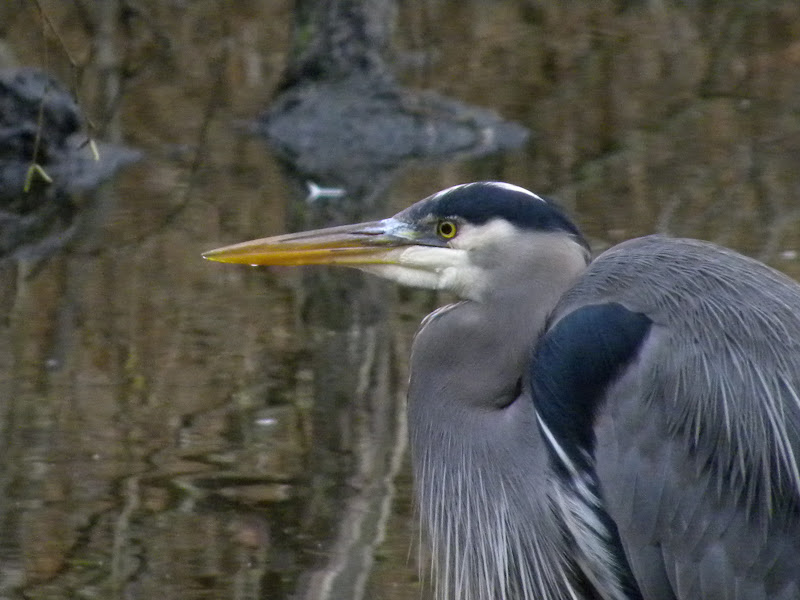
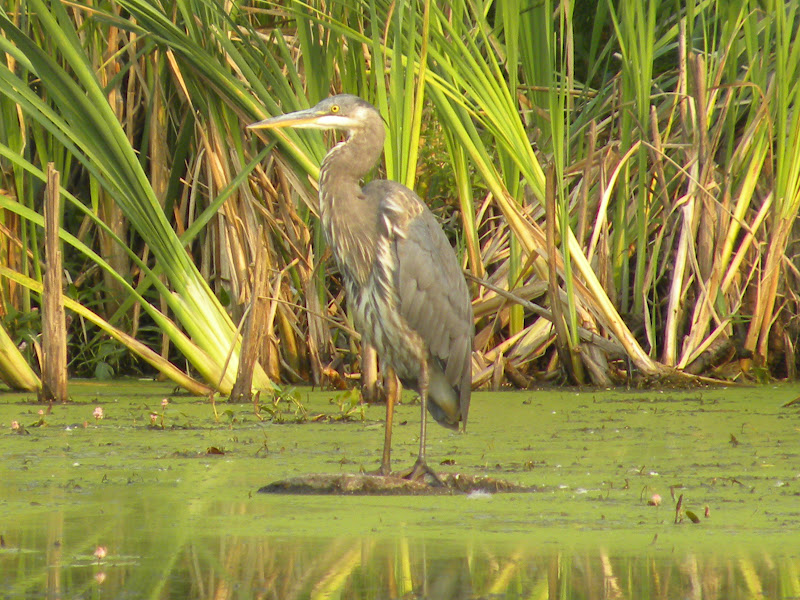
The Pacific GBH lives and feeds in this area year round. Apart from the mating and nesting season, they are solitary birds. Here are a selection of my heron sightings over the past year or so.


The Heron's neck and belly have beautiful feather patterns; the neck (shown in detail below) almost appeared to be braided grey, blue and burnt sienna colours.


Herons are often seen wading along shoreline of the ocean, ponds and lakes or in marshes; they stand motionless for long periods of time waiting for their prey to come in range and then strike very suddenly. They swallow their prey whole and can choke to death if the prey is too large.

I thought that they only ate fish, and that can be the primary part of their diet, but when fish are not abundant they also eat mice, frogs, lizards, snakes, flies, crabs, shrimp, crayfish and small mammals.

The blue heron has a harsh raspy croaky call, but they will shriek if they are disturbed or threatened. Follow this link for demonstration of heron calls.

I am fascinated by herons, they are magnificent birds.

This week I finished a watercolour painting of a Great Blue Heron which I named "Waiting Patiently":


The Travelling Wilburys "Handle with Care":

Thanks for stopping by, Happy Whimsy Wednesday, until next week...


Linking to: