Wednesday, 21 March 2012

Spring at last, a magic time!


Crocuses all in a row

Today I celebrate the arrival of Spring: spring sightings, magic and storytelling are on the agenda.

It is Spring at last; in fact today's Whimsy Wednesday is coming to you on the first full day of Spring. Spring officially started March 20 at 1:14 am EDT, this is called the Vernal Equinox (from "ver" meaning spring).

Forsythia

The start of Spring is marked by the equinox. Equinox is derived from a Latin word meaning "equal night", or equal daylight and night hours. The Spring and Fall equinoxes are the only dates of equal day and night and mark the time that the sun crosses the celestial equator, but it happens at a point in time and not actually on a particular "day". Here is an explanation from Wikipedia:
"At an equinox, the Sun is at one of two opposite points on the celestial sphere where the celestial equator (i.e. declination 0) and ecliptic intersect. These points of intersection are called equinoctial points: classically, the vernal point and the autumnal point. By extension, the term equinox may denote an equinoctial point.
An equinox happens each year at two specific moments in time (rather than two whole days), when there is a location (the subsolar point) on the Earth's equator, where the center of the Sun can be observed to be vertically overhead, occurring around March 20 and September 22 each year.
Although the word equinox is often understood to mean "equal [day and] night", this is not strictly true. For most locations on earth, there are two distinct identifiable days per year when the length of day and night are closest to being equal; those days are referred to as the "equiluxes" to distinguish them from the equinoxes. Equinoxes are points in time, but equiluxes are days. By convention, equiluxes are the days where sunrise and sunset are closest to being exactly 12 hours apart."

Spring flowers, warmer temperatures and longer daylight hours, bring it on. In the past few days I have noticed several people cutting their lawns, the smell of fresh cut grass brought memories of summer days rushing back to me.

Spring sights are all around me. There is new growth on the trees, a bright yellow green.


The Weeping Willows are budding, which makes them appear to be wearing lovely light yellow shawls draped over their branches. First a picture of the tree followed by detail of one of the branches.


Weeping Willow in bud

The perennials are starting to spout, the rhubarb is unfurling, the salmon berries have their first leaves and flowers and the pussy willows are popping open, these too are sure signs of Spring.

First Rhubarb shouts and leaves


Pussy Willows

And there are flowers. Colours popping up everywhere.


Cherry Blossoms


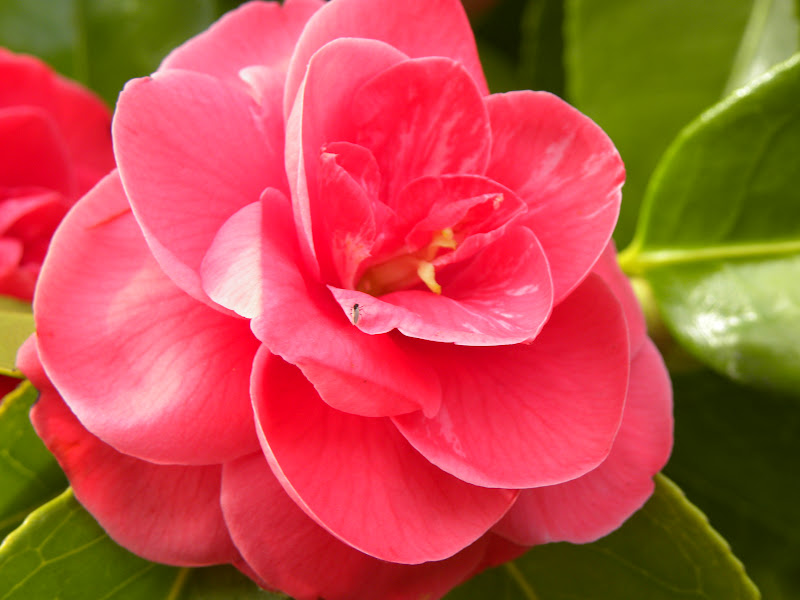
Camillia in bloom


Forsythia
Spring blooms in the park

Early daisies in the grass at the park

The birds are very busy eating, pairing off and getting ready to nest.


American Robin

Sparrows (above and below)


All this is happening at this time of year. But I referred to magic at the beginning of this post and that had to do with an egg. Here is a picture of a raw egg, balanced on its end. Why and how you may ask, well read on.


A raw egg balanced on my kitchen counter

According to folklore at the equinox it is possible to stand an egg on its end. Now this is something that I thought needed some investigation, and I do try to take my research seriously! So I have tried this out, starting on March 16, I was able to stand two different eggs (out of 5) on their ends, one stayed for about 20 minutes the other until the counter that it was standing on was jolted; sad story here, you remember the Humpty Dumpty tale, well Humpty ended up in the garbage after rolling to the edge of the kitchen counter and diving onto the kitchen floor.

I tried this out a few times and then on March 20, I was able to stand five eggs on end. I did not wait until the exact start of Spring, that being in the early morning hours here, a time meant for sleeping; after all we lost that hour last week with the change to DST. Spring magic or not here they are standing on end:


This may have nothing to do with the equinox but it I thought it made a good story and segue into the next topic.

The Spring equinox is also cause for celebration as "World Storytelling Day":

"World Storytelling Day, is a global celebration of the art of oral storytelling. It is celebrated every year on the spring equinox in the northern hemisphere, the first day of autumn equinox in the southern. On World Storytelling Day, as many people as possible tell and listen to stories in as many languages and at as many places as possible, during the same day and night. Participants tell each other about their events in order to share stories and inspiration, to learn from each other and create international contacts.
The significance in the event lies in the fact that it is the first global celebration of storytelling of its kind, and has been important in forging links between storytellers often working far apart from each other. It has also been significant in drawing public and media attention to storytelling as an art form." (Wikipedia)
At this point you will have to decide here whether I have been telling you a tale about the eggs or not.

Storytelling is a wonderful tradition, at times it seems to be a dying art form, so I was thrilled to discover that first there is a "World Storytelling Day" and second it is celebrated at the Spring Equinox.

As a blogger and a blog follower I delight in stories, I know that these are written and not oral, but I often feel I can "hear" the author telling me his/her story. On this first day of Spring, at the Vernal Equinox and on "World Storytelling Day" I want to thank all those who follow my blog, and thanks to all those wonderful bloggers out there whose blogs delight me daily.

So on this first day of Spring, take time to look at the flowers and watch the birds, tell someone a story and maybe even try to balance an egg. Oh-oh I see omelettes on the menu.

Here's a song to celebrate Spring: Morning has Broken - Cat Stephens


I have been busy painting again, this week flowers, in watercolour of course. I finished this one of tulips, called Pink Sunshine. I am almost finished another one of red tulips, but that will have to wait until next week.
Pink Sunshine


Happy Whimsy Wednesday, thanks for stopping by, until next week..............

Wednesday, 14 March 2012

Have you got the time?

My reliable Timex

Well, it is that time of the year again when we change our clocks to Daylight Saving Time (DST) or summer time, from Standard Time (ST). In doing this we gain more daylight in the evening but we lose an hour of sleep.

Why? Well good question.

According to Wikipedia:
"Though mentioned by Benjamin Franklin in 1784, the modern idea of daylight saving was first proposed in 1895 by George Vernon Hudson [8] and it was first implemented during the First World War. Many countries have used it at various times since then; details vary by location.
The practice has been both praised and criticized. Adding daylight to evenings benefits retailing, sports, and other activities that exploit sunlight after working hours,[9] but can cause problems for evening entertainment and other occupations tied to the sun.[10][11] Its effect on health and crime is less clear. Although an early goal of DST was to reduce evening usage of incandescent lighting, formerly a primary use of electricity,[12] modern heating and cooling usage patterns differ greatly, and research about how DST currently affects energy use is limited or contradictory.[13]
DST clock shifts present other challenges. They complicate timekeeping, and can disrupt meetings, travel, billing, record keeping, medical devices, heavy equipment,[14] and sleep patterns.[15] Software can often adjust computer clocks automatically, but this can be limited and error-prone, particularly when DST protocols are changed.[16] "

Sundials are only reliable for telling time when it's sunny
Most modern societies operate on a standard time schedule, where work, school, transportation schedules start at the same time each day regardless of the time of year, and the position of the sun. In non-equatorial regions the number of hours of sunlight varies with the time of year. So this time of year we change to DST by putting our clocks ahead one hour, that way we can make better use of the early morning light and extend the light into the evening hours.


"As days shorten again in autumn/winter, sunrises get later and later meaning that people could then be waking up and spending a significant portion of their mornings in the dark, so clocks are then returned to the "standard" time. The actual effects of DST can vary significantly by location depending on its latitude and position relative to the centre of its time zone. For example, DST is almost redundant in extremely northern/southern locations because the very long/short days mean that the artificial manipulation of time has little or no practical effect." (Wikipedia)

"Starting on 30 April 1916, Germany and its World War I allies were the first to use DST (German: Sommerzeit) as a way to conserve coal during wartime. Britain, most of its allies, and many European neutrals soon followed suit. Russia and a few other countries waited until the next year and the United States adopted it in 1918. Since then, the world has seen many enactments, adjustments, and repeals.[33]
  • Proponents of DST generally argue that it saves energy, promotes outdoor leisure activity in the evening, and is therefore good for physical and psychological health, reduces traffic accidents, reduces crime, or is good for business. Groups that tend to support DST are urban workers or professionals, retail businesses, outdoor sports enthusiasts and businesses, tourism operators, and others who benefit from increased light during the evening.
  • Opponents argue that actual energy savings are inconclusive, that DST can disrupt morning activities, and that the act of changing clocks twice a year is economically and socially disruptive and cancels out any benefit. Groups that have tended to oppose DST are farmers, transportation companies, and the indoor entertainment business. "

Apparently in the Soviet Union an official forgot to issue the edict to go back to standard time one Fall but the next Spring the edict was issued to go to DST!  It took some time to get the two hour shift fixed. 

Not everyone changes to DST, the chart below shows in blue those countries (or parts of countries) that do.


Although not used by most of the world's countries, daylight saving time is common in the Northern Hemisphere's northern latitudes.
  DST observed
  DST no longer observed
  DST never observed


And to make the situation more complicated not every country or area that switches to DST switches at the same time.

In Canada and the United States:
"Since 2007, daylight saving time starts on the second Sunday of March and ends on the first Sunday of November, with all time changes taking place at 2:00 AM (0200) local time. In 2011, daylight saving time began on March 13 and ended on November 6. In 2012, it began on March 11 and will end on November 4. In 2013, it will begin on March 10 and end on November 3."

But in other countries in the northern hemisphere the date for change is often a week or two weeks later and in the southern hemisphere it is time to switch back to ST from DST.

This link contains a list of the varying times for DST:
http://www.timeanddate.com/time/dst/2011.html

Some computers and phones change automatically, but most clocks do not and there are so many clocks in a modern household that making the change is a time consuming affair; and if you like all your clocks to say the same time this process takes even longer.


Just think how much time is taken changing some of these clocks each Spring and Fall:


Steam Clock in Gastown, Vancouver, Canada


So whether you are surrounded by traditional, cute or quirky clocks, I hope you have managed to change all yours and have them at roughly the same time.


The best part about changing to DST that we are almost at the Spring equinox (equal daylight and night hours). In the garden the early bulbs have been delighting us with colour, there are more bulbs to come but now there are also other plants and trees, like the lilac below in bud, that promise beautiful colour and fragrance in the not too distant future.

For some reason I have been craving colour this week. I painted the following three watercolours. The first two are of the Northern Lights (1 and 2) and the last one is a primitive perhaps, but colourful one of tulips (this one is a poured colour work).
Northern Lights 1

Northern Lights 2

Tulip Bouquet


Well that's all for this week, thank you for dropping by and Happy Whimsy Wednesday. Until next week............

Wednesday, 7 March 2012

Four and Twenty Blackbirds

Red-winged Blackbird

You are no doubt familiar with the English nursery rhyme "Sing a Song of Sixpence":
 
Sing a song of sixpence,
A pocket full of rye,
Four ands twenty blackbirds,
Baked in a pie.
When the pie was opened,
The birds began to sing;
Wasn't that a dainty dish,
To set before the king?
The king was in his counting house,
Counting out his money;
The queen was in the parlour,
Eating bread and honey.
The maid was in the garden,
Hanging out the clothes;
When down came a blackbird
And pecked off her nose.
There was such a commotion,
that little Jenny wren;
Flew down into the garden,
and put it back again.
A bit silly and nonsensical, but this rhyme "flew" into my mind when I started thinking about today's subject, the Red-winged Blackbird.

The common name for the Red-winged Blackbird is taken from the mainly black adult male's colouring and distinctive red shoulder patches, which are visible when the bird is flying or displaying.


 At rest, the male also shows a pale yellow wing bar.


The female Red-wing is blackish-brown, as you can see from the picture below, and is smaller than the male.

Female Red-winged Blacbird (above and below)


 Young birds resemble the female, but are paler below and have buff feather fringes. Both sexes have a sharply pointed bill. The tail is of medium length and is rounded. The eyes, bill, and feet are all black.

At this time of year they are gathering around the pond area in a nearby park. The males are displaying, either perched on a bull rush or atop a tree.


Red-winged Blackbird and reflection

Red-winged Blackbirds have a very distinct call and puff themselves up as they call. Here is a short video/ audio of Red-winged Black bird's song:


The Red-winged black bird is aggressively territorial and will attack much larger birds. Last Spring when out on a walk in the park, my husband and I were surprised by a group of Red-wings swooping down on us. It was a bit startling, and slightly reminiscent of Alfred Hitchcock's "The Birds", but in breeding season it is best to watch that you are not coming too close to their nesting territory. 


The Red-winged Blackbird is omnivorous, the main part of its diet consisting of plant materials, including seeds from weeds and waste grain such as corn and rice, and fruit (blueberries, blackberries) in season, but about a quarter of its diet consists of insects and other small animals, and this amount increases during the breeding season. The Red-wing forages for its preferred food of flies, moths, butterflies and dragon and damsel flies by picking them from plants or catching them in the air; but they will also eat snails, frogs, carrion, worms and spiders. They seem to happily accept seeds, bread  or suet as well.


Caught in the light the feathers on the male Red-wings backs and heads shine an irridescent blue colour.


Red-winged Blackbirds nest in small colonies, the nests are usually built in cattails, rushes, grasses, sedge or in alder or willow bushes. The female builds the nest of grass, sedge, moss and mud bound to grasses or branches above the water where it is well concealed.

Nesting in groups and nesting over water give them some protection from predators. The females and the young, with their brownish colouring, are well camouflaged while in the nest. The males often act as sentinels, and use a number of different calls to alert other birds to danger. Mobbing, especially by males, is also used to scare off unwanted predators, although mobbing often targets large animals, humans and man-made devices by mistake. Case in point, my husband and I taking an innocent stroll by the pond.


Display behavior, probably telling me to get lost!


Well that is the four and twenty blackbirds as promised by the title of this post. Beautiful birds, with a bit of attitude, they are so much a part of the spring sights and sounds around the pond now and through the summer. When out for a walk in the park I make time to stop and watch their antics and listen to their songs; on a warmish Spring day seated on a comfortable bench it is a simple but distinct pleasure.

I have not been around to your blogs as often as I would like recently for two reasons: I have been getting my Mother settled in a new setting after she fell recently resulting in a compound fracture in her lower back and second I have been having more and more trouble seeing, especially the computer screen. My Mum is slowly getting settled in a more supportive setting and I am scheduled to have cataract surgery soon. All good news, so bear with me, I appreciate everyone's support and comments and will get around to visit other sites as much as possible.

Work is progressing somewhat slowly in the studio. Here is the finished  watercolour of  Pink Poppies and below it another "poured" work of Rose hips. I think I will be painting some Red-wings soon, this post has given me inspiration and ideas.


Pink Poppies


Rose Hips

A song, not about Red-winged Blackbirds but Blackbirds, but an old favorite:


Thank you for stopping by, I appreciate your visit, and a special thank you to everyone that takes time to comment. Happy Whimsy Wednesday, until next week...........

Link to Wild Bird Wednesday: